

Adapting to Change: Europe’s Economic Strategy in Trump’s New Trade Landscape
Last Updated on 16 June 2025 at 18:08
Let’s face it: Europe just got a wake-up call, and it’s name is Donald Trump. As Trump rolls out his latest plan for America First, it’s starting to look like it might be Europe Last. European newspapers are calling it a “storm,” “shockwave,” even “economic doom.” Why ? Because Trump’s tariff plans aren’t just aimed at China — they are aimed at everyone else too.
America’s new trade strategy under Trump is basic: build the wall, but make everybody pay for it. The new tariff increases will likely hammer European exports, sending Germany’s auto industry into a tailspin, rocking Switzerland’s luxury goods sector, and potentially setting the stage for a transatlantic economic showdown. And guess what ? Trump’s betting America will come out on top.
Table of Contents
The Tariffs’ Tornado
Let’s start with Trump’s favorite economic tool: tariffs. Tariffs are not only taxes but weapons, and Europe is the next battleground. The DAX index turned red as soon as Trump’s victory was announced, with stocks of Germany’s crown jewels — BMW, Porsche — taking major hits. Investors aren’t just nervous; they’re in full-on panic mode, imagining a world where American consumers balk at the price of European cars and luxury goods.
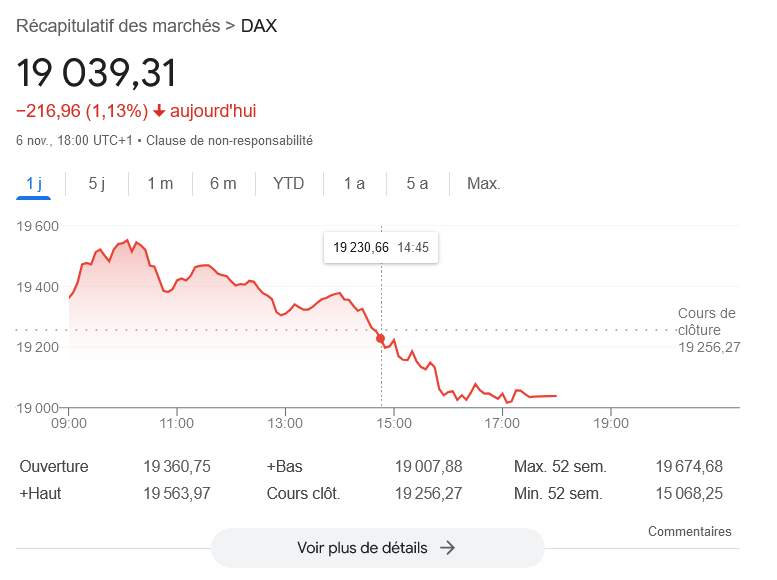
Trump will likely raise tariffs on foreign goods to make American products cheaper and, more importantly, dominant. This isn’t just protectionism but a sort of an economic wall built around the U.S. to keep out foreign competition. For such European and Swiss manufacturers that’s a death sentence unless they start manufacturing more on American soil. But even then, Trump’s stance is clear: you play by America’s rules, or you don’t play at all.
And who’s the big loser here ? Europe. With proposed tariffs of up to 60% on Chinese imports and a 10-20% hit on European goods, Trump’s making sure that “Made in America” is the only label Americans see first.
Trump has made it clear: tariffs on imports will soar to 10-20% for European goods and as high as 60% on Chinese products. Germany, with its manufacturing-heavy economy, is reeling.
For the EU America isn’t just a trading partner; it’s Europe’s biggest export market. Roughly 20% of the EU’s exports are U.S.-bound, and Switzerland, despite its neutrality, sends 18% of its goods to American shores. This number is not a minor headache — it’s a migraine for all Swiss politicians — even Micheline Calmy-Rey is worried for the foreign policy and Swiss economy. If U.S. tariffs crank up, European, including and Swiss exports will likely face a wall, and with that comes job losses, GDP slumps, and political unrest. In short, the European economic engine is under threat.
Globalization Fragmented: Europe Scrambles to Catch Up
Trump’s first term gave Europe a taste of economic nationalism, but they didn’t believe it would stick. Since Trump’s first term, the global trade system has been eroding, and supply chains are fragmenting. The U.S. and China are adapting, securing their resources, and finding ways to “onshore” production. Europe ? Not so much.
Lombard Odier’s chief economist, Samy Chaar, summed it up best and gave a positive message about “economic normalisation, despite the geopolitical uncertainties“. Indeed, while the U.S. and China have took some steps to adapt to this new economic reality, Europe has been sleepwalking. This region looks more comfortable in a world of open borders, easy trade, green energy strategies, and shared resources, assuming that multilateralism would always be there to protect them.
Trump’s tariffs are likely to force Europe in rethink its strategy, and do it fast in the sense of crisis management — and especially on the energy part. European nations will have to secure their supply chains, reduce dependency on the U.S., limit its reliance on foreign oil, gas, and on top of that, find new markets for their products and services. Quite a list.
But there’s a problem: Europe lacks unified leadership on this front. The EU is a patchwork of 27 nations, each with its own agenda, and the result is indecision when decisive action is what’s needed. Europe may talk a big game about unity, but when it comes to economic resilience, it’s lagging behind — even in terms of salaries and innovative companies.
And Trump knows it.
Trump’s Inflation Game: Who will Pay the Price ?
Trump’s tariff strategy may protect U.S. industries, but economists warn it could also supercharge inflation. American consumers are already facing higher prices for imported goods, and will feel the pinch of “Made in America” as price increases will fast creep into their daily lives. But for Trump, that’s a small price to pay if it means reenergizing American industry and create jobs. Consumers, already desensitized by inflation sticker shock, might barely blink – after all, patriotism might become the new premium.
The math is brutally simple: foreign goods come at a premium. Besides, Switzerland is applying a very similar strategy for years.
Under Trump, “America First” is no longer just a slogan — it’s an operating system. Companies are either in line with that vision, or they’re out. It’s capitalism with a twist of nationalism, and while critics are quick to call it dangerous, this vision looks laser-focused: protect American jobs, build or re-build an American infrastructure, and create an America that doesn’t rely on anyone.
This approach is not just about keeping out imports — it’s more about reshaping America’s economy landscape, shifting it from a consumption-driven economy to a production powerhouse. The main purpose is to push towards innovation instead low-cost production, smart economic growth, and a renewed sense of American pride.
For Europe, that means adapting or facing a stark choice: fall in line or fall behind. Leaders in Brussels are calling for “strong decisions,” but those decisions are getting lost in bureaucratic red tape. Europe’s leaders need to move from debate to action, but can they ?
If Europe wants to survive the Trump wave, it needs a full-on strategy shift. First, secure supply chains – Europe’s reliance on U.S. and Chinese exports leaves it dangerously exposed. Second, embrace a new economic order where self-reliance isn’t optional. And finally, Europe needs a unified trade and economic policy that can stand up to Trump’s “America First” agenda. Without decisive leadership, Europe risks being left in the dust.
However, the Trump’s second term could be the best thing that’s happened to Europe and Switzerland.
The Trump Effect: the Economy Redefined
For Europe, Trump’s re-election in 2024 is not just an American issue — but more about a tectonic shift and a rewrite of global economic rulebook — quite a crisis management. His protectionist policies, if implemented as he said, will likely force every nation to reassess its strategies, resources, and priorities. And while the initial reaction is shock and dismay, there is a golden opportunity here. Europe has an opportunity to grow up, step up, and redefine its own strength.
The old, cooperative model is out and the new model is survival of the fittest.
Will Europe rise to the challenge and handle itself ?
Only time will tell.
For Europe, it’s time to make a move.
Switzerland is likely to wait and follow.

Elena Debbaut is a strategic execution expert to boards and executive teams. She leads and advises on complex transformations when governance barriers, internal politics, or structural fragmentation prevent organizations from executing critical decisions.
Specialities:
• governance-constrained transformation
• operational restructuring
• strategic recovery & execution