

When Everyone Can Create with AI, What Are We Still Paying For?
Last Updated on 30 October 2026 at 18:21
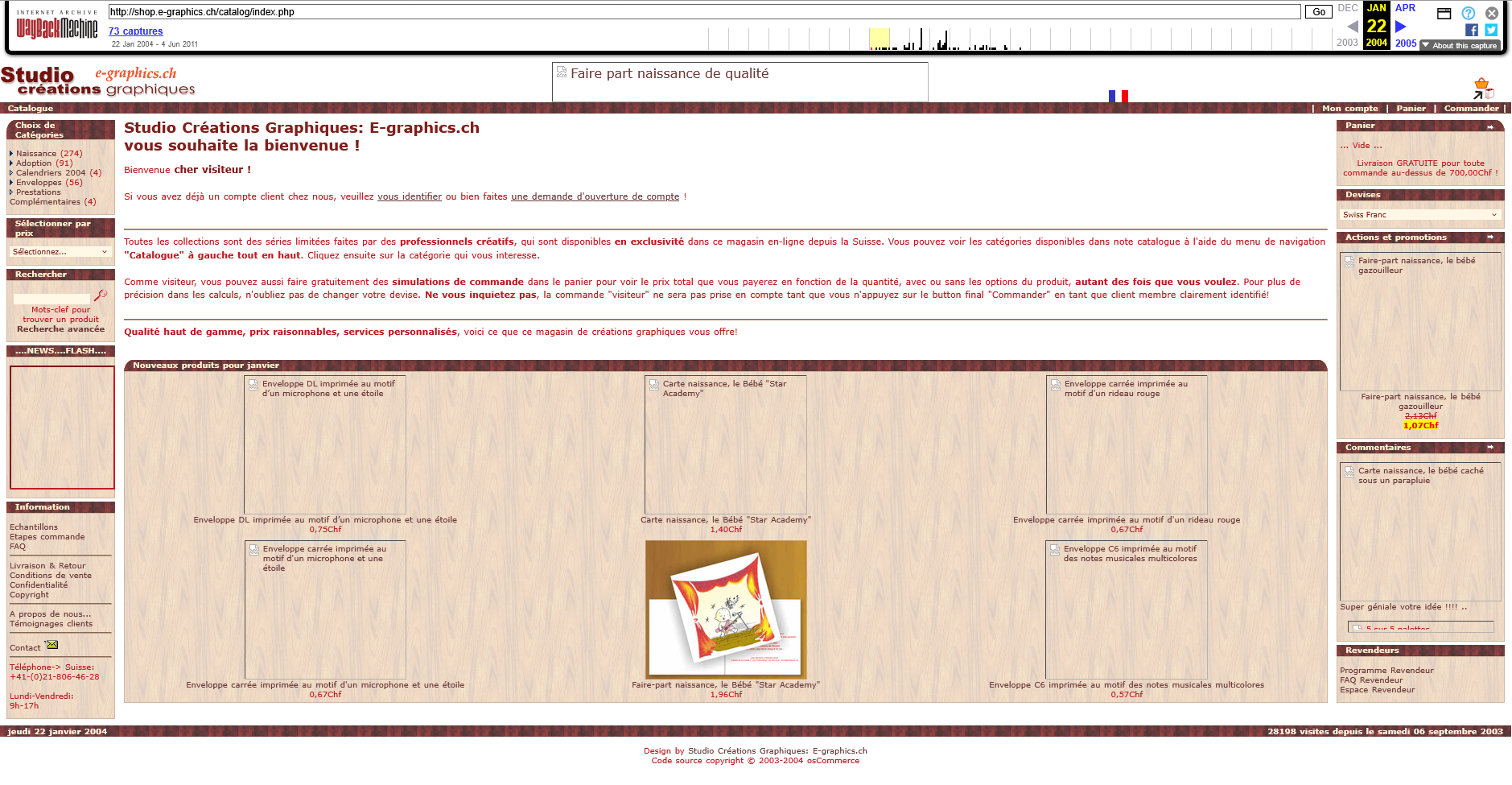
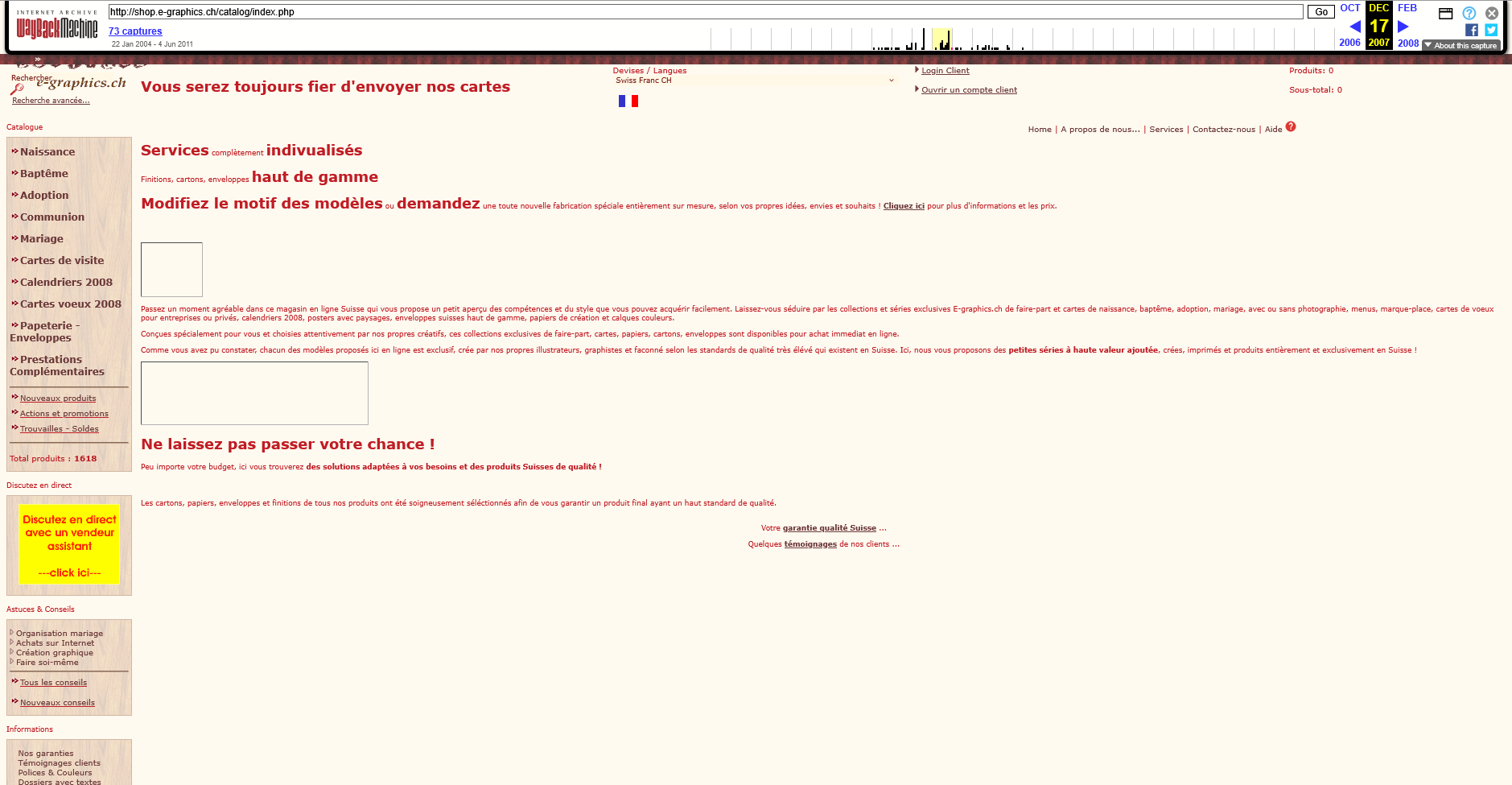
In the early 2000s, I was selling illustrated birth announcements and wedding invitations online, first through a subdomain shop.e-graphics.ch of my E-GRAPHICS agency specialized in visibility and MarTech and later through a dedicated new brand and domain name called Joli-Cards.
The original shop is still visible in the Internet Archive.
Its December 2007 storefront displayed a few hundreds of catalogue products; and online records show 1,809 listed products on 5 October 2017. The catalogue included birth and wedding cards with illustrations drawn by me or created with freelance collaborators, alongside envelopes, stationery and other complementary products. The finished cards were printed, personalized and delivered to customers in less than 24 to 48 hours.
Behind this apparently simple proposition stood a rather less romantic enterprise: Didier Debbaut and I had written more than 30’000 lines of custom software around an open-source e-commerce platform, because the available system OsCommerce did not adequately handle the way we actually worked.
Quantity-dependent prices, paper and printing specifications, manufacturing choices, bespoke requests and different delivery arrangements all had to function together. As early as 2004, visitors could simulate an order and calculate a price before committing to purchase. A customer could admire a drawing, choose a layout design and place an order in minutes. Making that transaction work reliably had required years of creative, technical and operational decisions. A lovely illustration was of limited commercial use if the wrong options reached production, the price was calculated incorrectly or the finished invitations arrived after the wedding.
Then people began copying our illustrations and ideas. A lot of our customers purchased only the minimal quantity, then photocopy on a cheaper paper and with lower quality output.
It was a useful education in how readily the market can admire creative work while showing considerably less enthusiasm for paying the person who conceived it. At that time, there was no generative AI to blame. Copying needed little more than access to the visible result and a willingness to take somebody else’s investment in thinking and working.
Today, almost a quarter of a century later, AI can produce attractive imagery, working software, persuasive prose and plausible business presentations in minutes. And now we are having a passionate discussion about whether people who use these tools deserve to call themselves creative.
I understand the concerns about appropriation rather well.
I am less persuaded by the suggestion that a creative act becomes illegitimate because its tools have become accessible.
Table of Contents
When difficulty became a business model
Professional expertise has always combined several forms of value such as knowledge, judgment, technical ability, reliability, originality and especially the capacity to take responsibility for a result. Scarcity added another component to this mix.
Indeed, when only a limited number of people could draw commercially acceptable illustrations, build an online shop or produce an intricate financial model, access to those capabilities commanded a premium selling price. The premium was economically understandable, though it was not always a precise measurement of the quality delivered.
Over time, industries developed credentials, working methods, specialized vocabulary and certificates. Then it started to elaborate complex production processes around these capabilities. Some work and strategy processes served indispensable purposes. Others made ordinary work appear more mysterious than it was.
If a complex eCommerce website took six month to build with a team of 4 people, the timetable could reflect genuine engineering, testing and integration. Such a work could also reflect a process in which relatively modest work passed through an impressive number of hands. The invoice rarely explained the distinction.
AI is making that distinction more visible.
Someone without formal training can now draft a serviceable application, produce competent visual concepts or prepare presentation material that looks remarkably similar to work previously delivered by a specialist.
The result may still contain serious defects. But where it genuinely meets the customer’s requirement, the old production barrier no longer provides an adequate explanation for the old price.
This affects professional identity as much as commercial margins. Years spent acquiring a skill represent effort, sacrifice and an understandable source of pride.
So today, when a “newcomer” can reproduce part of the visible result in an afternoon, some people experience the change as a judgment on their own worth.
It is a deeply human reaction; but it is also a poor basis for deciding who should be permitted to create.
A profession can retain considerable expertise after losing its exclusive control over routine production. The difficulty is that customers have not always paid separately for those two things. Many suppliers have been happy to collect the premium prices without explaining which portion purchased professional judgment and which portion purchased the absence of alternatives.
The uncomfortable mathematics of accessible competence
The effects are measurable, although they are not uniform.
A 2023 study of generative AI in customer support, involving 5,179 agents, reported an average productivity gain of approximately 14%. The largest gains were concentrated among less experienced and lower-skilled workers, while the most experienced benefited much less. Such a finding is a result from one type of work, within a particular operating environment, and it cannot be applied indiscriminately. Industries such design, programming or consulting are different. It nevertheless illustrates a commercially significant mechanism: technology can give less experienced people access to patterns of performance that previously took much longer to learn.
In some fields the AI usage will improve the minimum acceptable standard.
In others it will broaden participation, accelerate experimentation or make services affordable to customers who previously went without. The consequences for suppliers will be uneven.
Lower production costs can enlarge a market and reduce prices at the same time, but they can also reduce the earnings of accomplished professionals whose work competes with newly abundant alternatives.
It would be intellectually convenient to pretend that only mediocre practitioners will suffer. Economics has no particular obligation to reward excellence when customers cannot recognise it, do not need all of it or will no longer pay for the difference.
The strategic question for a firm therefore changes. When competent output becomes relatively inexpensive, what does a customer still have good reason to commission, trust and pay for ? More elaborate descriptions of the production process will not answer that question. Neither will the assurance that a real person spent many hours doing something a machine could have completed quickly.
Copying, ownership and the rather selective defense of craftsmanship
Having seen original illustrations copied as well as my business articles, I have little patience for the fashionable claim that creative ownership is an imaginary concern invented by people frightened of technology.
The cost of developing a distinctive product is real. So is the damage when somebody else can appropriate its protected expression without bearing the original cost. Questions about the use of protected material in AI training, permission, attribution and remuneration deserve of course, a serious treatment. In 2025, the OECD’s 2025 assessment of intellectual-property issues in AI training data illustrates why these questions cannot be waved away with a slogan about innovation.
But ownership of a particular illustration does not confer exclusive ownership of the ability to illustrate.
The same principle applies to software, writing and design.
A programmer may have legitimate rights in code they wrote without acquiring a permanent commercial entitlement to every function that code performs. A marketing agency may deserve protection for original material without gaining a veto over a customer’s decision to create its next campaign differently.
These distinctions require care because the relevant rights depend on the work, agreements and jurisdiction; as there is no universal exemption merely because an AI system is involved.
There is also a commercial inconsistency worth examining.
When inexpensive design software, stock imagery, templates and open-source platforms reduced production costs, many businesses readily adopted them. Customers were encouraged to appreciate the efficiency and low pricing offerings. Now that the same pressure is reaching services previously sold at professional rates, the vocabulary of authenticity and craftsmanship has become rather prominent. Sometimes it expresses a genuine commitment to quality. But more often than not, the timing and especially the cost is remarkably convenient.
We had already learned something about this with our personalized printed cards.
Copying a design could reduce the effort required to offer something visually similar. But it did not automatically reproduce elements such as the commercial understanding, product assortment, ordering logic, market needs, production arrangements or service quality and discipline behind the original business. The visible object was easy to imitate. The operating system around it was much less obvious.
Why the accusation of “AI slop” gets only half the argument right
I have been critical of mass-produced corporate content before. For instance, in an earlier essay on the black-market bazaar of corporate content, I described a copyright infringement industry capable of manufacturing an extraordinary quantity of words with very little reason for anybody to read them. AI has made this industrial habit faster and cheaper; but with less obvious criminal offenses. The criticism still stands.
For instance, low-cost content production can flood a market with material that is grammatically polished, visually pleasant but … intellectually interchangeable.
The problem existed before generative models. We had generic stock imagery, derivative campaigns, recycled management presentations and articles assembled largely to occupy search results. AI has accelerated the supply and reduced the cost of joining in.
Research suggests a more interesting tension than the familiar argument between human originality and machine imitation. A 2024 experiment published in Science Advances found that access to AI-generated story ideas improved assessments of individual short stories, especially among less creative writers. Yet the AI-assisted stories were also more similar to one another. In that specific experiment, individuals could produce stronger results while the collection as a whole became less diverse. That is a useful warning about conformity, not proof that all AI-assisted creativity lacks originality.
It would be intellectually lazy to praise a poorly designed advertisement because its creators suffered over it, while dismissing a compelling one because an AI tool helped produce it.
Equally, generating hundreds of polished variations cannot compensate for the absence of a worthwhile idea. Creative quality remains something to examine in the work, its purpose, its originality and its effect, rather than infer from the prestige of the method used to manufacture it.
The invoice is becoming a more interesting document
The consequences of AI work extend well beyond illustrators or advertisement creatives.
Consider a software supplier billing for a routine feature, a marketing agency producing familiar campaign variants or a consultancy preparing another handsome analysis of a problem the client already understands. As production becomes cheaper, clients acquire the means to challenge the costs, delivery time and even the value of such work. Some will do so intelligently. Others will underestimate the less visible work that makes a result smart, maintainable or commercially useful.
A functioning demo for a WP plugin or a game is not necessarily a deployable or long term maintainable software. An attractive idea, with nice images is not necessarily a marketable product to sell. A fluent turnaround or restructuring proposal is not the same as having the know-how in restoring liquidity, reallocating responsibilities or pivoting strategies.
Anyone who has dealt with the consequences of a failed software release, a production mistake or a stalled transformation knows that the final one percent can require considerably more judgment than the first convincing presentation.
As such, business organizations should examine the entire cost of an outcome with elements such as the initial production, validation, integration, correction, maintenance, liability and more importantly, the opportunity cost and time lost when the result fails. This is also where expert professional providers can justify substantial fees, provided their evidence is stronger than their adjectives.
In practice, if the supplier can demonstrate that they reduce risks, solve a difficult operational problem, or preserve a valuable capability, then there is a defensible economic proposition. On the contrary, if the principal argument remains the number of hours required to prepare the deliverable, the customer is fully entitled to ask whether those hours are still necessary.
That question should be especially familiar to the consulting industry I wrote about this here.
I have a sufficiently long professional life to notice that business organizations have spent extraordinary budgets just for commissioning a lot of diagnoses, programmes and governance structures that circulate through meetings. The result of such roadmaps is more often than not is absent or have a limited impact on how the business operates.
Today, AI can now produce a respectable first version of many of those documents at negligible marginal cost. This approach does not mean an executive can safely automate a turnaround or a restructuring. It does mean either that charging a premium price for a file alone is becoming harder to defend. In practice, the gap between technological output and operational execution remains the expensive part, because it often involves decisions based on constraints and consequences.
The adjustment to AI-based work is not confined to suppliers.
Buyers will need greater discipline as well.
A low price attached to unreliable work can become extremely expensive and faster than the AI-delivered work. A high price attached to a basic, no complex work can be equally irrational. The best practice would be for procurement to know how to examine the problem and acceptance conditions. Those elements must be verified independently and also, deciding who will deal with the possibility of a failure. The purchasing decision becomes more sophisticated when the ability to produce a polished artefact is no longer sufficient evidence of competence.
What happens when the old expertise barriers disappear
Broader access to creative and technical tools is a legitimate social and economic gain.
A person without formal design training can give visual form to an idea. A small business can test small software that would once have required a substantial development budget. Specialists can spend less time on routine production and more on difficult work.
None of this guarantees equal opportunity: access to reliable AI-frontier models, computing capacity, or precise data. The distribution is itself uneven, and the commercial power once held by professional intermediaries may migrate toward AI-technology platforms. Removing one barrier does not prevent another from emerging.
For experienced professionals, the opportunity is to use the tools without reducing their ambition to easier work. Their expertise remains valuable when it is visible in the quality of those decisions and in the results achieved. Credentials and years of practice still matter. Such professionals and experts can investigate more possibilities and test assumptions earlier. They can also devote more attention to the decisions that determine whether an outcome have better chances to succeess.
For companies, the same principle applies at organizational scale.
Technology adoption should prompt a review of which activities still require specialist judgment while others can be automated safely. Keeping an obsolete process because it protects a professional hierarchy and tribes is an expensive form of corporate politics. At the same time, replacing qualified people and experts layoff just because a model produced a persuasive prototype can become considerably more expensive.
I sometimes think back to the illustrations we sold online before the AI era.
Producing the artwork required imagination and skill. Turning it into a business required software, production arrangements, customer understanding, economic choices and constant practical correction. When our designs were copied, I had reason to care about ownership. At the same time, I never believed that protecting our work should mean preventing anyone else from learning to draw, building a shop or competing with us.

AI has brought that old distinction into a much larger market.
Today, it is perfectly reasonable to defend original work and demand competent outcomes. However, it is far less reasonable to expect customers to keep paying for “human effort” after much of that difficulty has been removed. The commercial terms of expertise will have to be earned again.
Having had my own illustrations and business publications copied en masse, I need no lectures about the value of original work. I also remember very well what it took to turn those illustrations into a functioning business: thousands of decisions involving software, pricing, manufacturing, delivery and customers who expected things to work. That was expertise earning its keep.
When technology can accomplish in a couple of minutes what once required minimum two intensive work days, customers are under no moral obligation to preserve the original work’s invoice. Originality, judgment and accountability can still command a premium selling price, provided they make a difference worth paying for.
As for those whose principal competitive advantage was the human difficulty of doing something, I suspect the coming years will provide an excellent opportunity for professional reinvention.
Preferably before the next client asks what, exactly, and why they are still paying for.
Related Debbaut.Solutions reading: Open vs. Proprietary Standards · Strategic Execution & Transformation Portfolio · Execution and Transformation Services.

Elena Debbaut is a strategic execution expert to boards and executive teams. She leads and advises on complex transformations when governance barriers, internal politics, or structural fragmentation prevent organizations from executing critical decisions.
Specialities:
• governance-constrained transformation
• operational restructuring
• strategic recovery & execution