

Two Household Used Keys, a €44 Supplement Asked with No Explanations, and an International Tour of DHL Express Corporate Bureaucracy
Last Updated on 18 October 2026 at 13:01
FIELD CASE | CROSS-BORDER OPERATIONS, BILLING AND EXECUTION GOVERNANCE
It took two used household keys in an envelope weighing less than 100 grams, to produce an unexpectedly thorough introduction to the administrative geography of DHL Express. The company charged us CHF 84.65 to send them from Switzerland to Belgium. Then the family member recipient in Belgium was asked for another €44 with no explanations. At the time of writing, we were still waiting for the most elementary piece of information in this international transaction: what, precisely, is the additional money asked for and why ?
In this case, there was no sale, no commercial consignment and certainly no ambitious attempt to establish an international second-hand key business. We just needed to get two small objects into the right hands, promptly and reliably, while dealing with considerably less trivial family matters. And at this stage, DHL Express failed its job.
We selected an express courier and paid accordingly. What followed was a customs-document request, two inconsistent nominal values in the paperwork, an additional demand addressed to the recipient and a customer-service excursion between Switzerland and Belgium. Somewhere along the way, the paying customer we are acquired an additional role within DHL: become an unpaid coordinator of a multinational company’s internal inquiries.
I have spent much of my professional life examining what happens when responsibility passes between functions, organizations and countries. Usually, a restructuring and turnaround programme worth millions is required to make the absurdities sufficiently visible. In this instance, two used keys and a small investment managed it with admirable efficiency.
Table of Contents
The shipment: remarkably little to transport, considerably more to administer
The shipment was arranged on 11–12 October 2026. We understood that delivery was expected on Tuesday 13 October, although the material available to us does not establish a guaranteed contractual deadline. Of course, cross-border clearance from a private person to another private person can affect transit times. The simple fact that an expected delivery date is exceeded looks like a breach of the transport agreement paid for.
| Item in the record | Documented detail |
|---|---|
| Contents and route | Two used household keys, private sender in Switzerland to private recipient in Belgium |
| Actual and billed weight | less than 0.10 kg; yet 0.50 kg billed |
| Transport charge | CHF 79.50 |
| Demand surcharge | CHF 0.15 |
| Direct signature service | CHF 5.00 |
| Total paid to send the shipment | CHF 84.65 |
| Value on the original shipping receipt | CHF 4.00 |
| Value on the later pro forma document | CHF 1.00 |
| Additional amount requested from the recipient | €44, not yet itemised in the correspondence available to us at this publishing stage |
A courier charging on a minimum billable weight is perfectly ordinary. We do not dispute that line merely because the keys weighed less. It is possible that we introduced ourselves a little discrepancy by a honest mistake between private individuals: CHF 4 on the initial receipt and CHF 1 on the subsequently asked by DHL pro forma invoice. That inconsistency should have been avoided. We acknowledge it, and DHL might be entitled to clarify the declaration. However, at this stage, such a record does not explain the additional charge of €44, nor the delivery interruption.
A note on the DHL ServicePoint experience
DHL Switzerland later suggested that the ServicePoint had contributed to the problem. Our experience does not support that explanation.
At the DHL ServicePoint we visited, there were no shipping pouches, no pens, no glue and no facility to print the required documents. Customers were simply referred back to DHL’s online process, despite those services being presented online as available through ServicePoints. In practice, the ServicePoint functioned only as a drop-off location. The shipment data and documentation process had already been handled through DHL’s own systems.
This precision matters because blaming the ServicePoint does not explain what happened later in the customs process. DHL had the booking data, requested the pro forma itself and received the additional documentation. The relevant question therefore remains what DHL transmitted for customs clearance, not whether a local drop-off point had a printer or a pouch.
Indeed, just after the booking, DHL Switzerland asked for a “pro forma invoice” identifying the shipment for customs purposes. We supplied one as requested, explaining again that the keys were used personal items sent between relatives without a sale. Yet, the transport paperwork carried the designation “Dutiable”. That designation is a classification in a shipping workflow we have no control on it; and again at this stage it does not establish if and what the Belgian authorities ultimately assessed, or whether a particular tax or fee was legally due.
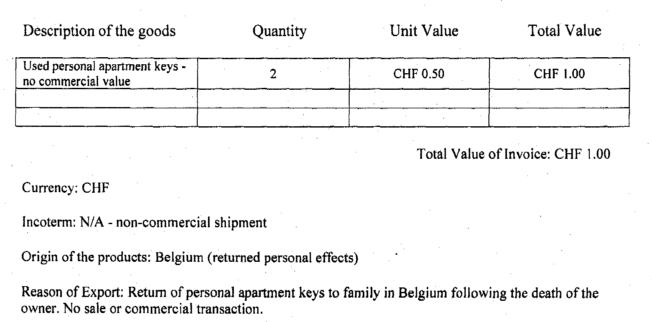
In the meantime, the person waiting for keys received a request for €44 to pay immediately. This part, for an old relative, was an especially inelegant moment in the delivery process. The physical objects had barely any commercial value, yet the administrative uncertainty had already acquired an expensive price tag, without any justification.
The €44 charge is a precise amount. Its explanation is still in the DHL transit.
The first question is straightforward: how much of the €44 represents a public charge imposed under Belgian “import” rules between private individuals, and how much, if any, represents a private DHL service fee that might be self-created ?
There may be several components. In particular cases, a legitimate customs duty, an import VAT assessment and a courier’s charge for a separately identifiable clearance service are different things, with different triggers and different supporting records. Bundling them into a single unexplained amount makes it impossible for a recipient to check the bill intelligently.
This is particularly unfortunate because DHL already publishes the taxes needed to explain such charges.
Indeed: its DHL Belgium Service & Rate Guide 2026 lists, among other customs services, €10 for Clearance Processing, €20 for Customs Physical Intervention and €45 for Non-Routine Entry (printed page 22). The same guide lists a minimum €15 Duty Tax Processing charge for non-account customers (read private people), applicable where the relevant fiscal charges exceed €5 (printed page 20). Those are official, published tariff categories; and they are not a diagnosis of this particular €44.
There is a temptation to assemble the tariff amounts, add a convenient percentage and announce that the mystery has been solved. However, people asked to pay for something generally prefer clear evidence. As of the publication date, we have no itemized assessment showing which category was applied on those used keys nor why, what processing actually occurred, which taxes were collected, or on what value. And no arithmetic reconstruction can replace the missing record from DHL itself.
The Belgian Federal Public Service Finance also describes a conditional exemption for occasional, free, non-commercial consignments between private individuals, with a goods-value limit of €45 and additional requirements.
This shipment appears relevant to that regime: the used household keys were sent between two private individuals, without payment for the objects, for a strict family purpose. Transport costs can of course, enter the VAT calculation when an import is taxable. Again, that general rule does not tell us whether this shipment was taxable, how it was assessed by who, or whether DHL supplied an additional chargeable service. It simply gives us one more reason to ask for the calculation rather than invent it on the customer’s behalf.
The €44 might ultimately be entirely justified. If so, DHL should be able to show how. An international courier’s tariff should not require a whole family to conduct a forensic reconstruction of DHL billing system.
One global brand well defined, but with several undefined destinations for responsibility
When we queried about this €44 charge, DHL Belgium initially directed us towards DHL Switzerland, where the shipment had originated. DHL Switzerland was the point of purchase and Belgium was where customs clearance and the demand addressed to the recipient were being handled. Yet, the DHL Switzerland lead us gently to the DHL Belgium and reverse.
After a back-and-forth, the Belgian customer-service function later forwarded the charge-specific question to a specialist duty-and-tax team. That referral was a useful step, although the requested legal explanation had not reached us at the time captured in this article.
From a management perspective, the detail is revealing.
The client buys a service under one name, DHL Express.
Internally, the transaction passes through national operations, documentation, clearance, billing and support. There may be perfectly reasonable legal and operational boundaries between them. At the same time, some private customers should not need nor forced to understand those boundaries, find their intersections, and establish why somebody wants those €44.
I cannot inspect DHL’s internal responsibility matrix from our correspondence, and this case does not establish how this company manages such cases throughout its network. However, such a case, alongside with thousand of others establishes just that the customer-facing and experience of such transactions is quite bad experience. Several contacts later and a cross-border referral were needed, and … still no itemized billing detail. Of course, in some particular cases, an internal transfer may be a necessary procedural step. To the customer, this looks just plain bad and amateurish.
The phenomenon is depressingly familiar in larger operations. Each department may comply with its local procedure while the overall outcome remains unresolved for the paying customer.
The origin office DHL Switzerland holds the booking information while the destination office sees the import event. The DHL billing knows the charge; yet service personnel have the puzzled customer. All the constituent parts can be busy, courteous in theory, and technically correct. The paying customer is still doing the integration work between all those tribes … and for free.
DHL’s own 2026 worldwide guide is headed “Connecting Your World”.
I would settle, for the moment, for connecting their internal booking, customs and invoicing explanations.
Considering such a negative experience, and thousand others, their DHL Global Connectivity looks like a rather exotic promise when a question about two used keys must first undertake an international tour of customer service. A couple of supplementary numbers: the Switzerland Side (dhl.ch) TrustScore: is ~1.5 of 5 while the Belgium Side (dhl.be) has a TrustScore: ~1.2/5. As for dhlexpress.be it is also qualified as bad, with only 1.6 on 5. Quite insufficient, some might say.
Procedures have practical value when they enable a decision to be owned, evidenced and completed across the boundaries that the organization itself has created. The same governance problem is examined in When Rules Stop at Documentation: Recurrence and the Governance Gap.
The economics of making the customer work
The monetary disagreement is €44, a figure small enough to disappear into a corporate variance report and large enough to irritate any reasonable recipient who has not been told what it covers. The original CHF 84.65 had already purchased the transport and duty services. Since the currencies differ, adding the two figures without conversion would create yet another piece of bad arithmetic. The economic question lies elsewhere.
Our family spent time preparing initial document, then adding an additional pro-forma customs document, contacting service teams, clarifying the nature of the goods, checking the tracking record, and unsuccessfully seeking an explanation of the requested amount.
On DHL’s side, we like to think that the matter reached national support and a specialist review function. We do not know the company’s actual handling costs, the number of internal touches or whether the €44 contains any net revenue to DHL, and I will not pretend otherwise.
But a manager looking at such an exception should ask a rather uncomfortable question: what resources did the system consume to administer, defend or reconsider a small charge, and how much of that work was transferred to the customer ?
It is entirely possible for a valid fee to sit inside an inefficient process, or a self created work to invoice the paying customer on an unknown legal basis. It is equally possible for an incorrect charge to remain unresolved because no single team sees both the commercial promise and the operational evidence.
Anyone responsible for turnaround or operational restructuring will recognize the underlying cost mechanism. Fragmented accountability manufactures avoidable coordination via repeated and unneeded contacts, thus making ordinary decisions needlessly expensive. Looks like a pure communist system where an organization is creating work for itself and be paid for it.
The absent invoice for €44 carries one precise number; while the exception consumes time and money in several places. When an organization measures the final charge only but overlooks the effort surrounding it, then the customer ends up paying the gap between the brand’s promise and the field reality.
What competent governance would look like
I would not propose a transformation programme, a new steering committee or twelve months of consultants to improve the processing of two used household keys delivery.
Indeed, a sensible control design would have detected the missing customs document and contradictory values as early as practicable, told the sender automatically what needed correction and retained a trace of the agreed declaration. If a new amount was raised, the billing record would identify its constituent legal taxes and services when due, their triggers, the tariff or legal basis and the party responsible for the decision.
Above all, one identifiable case owner would coordinate the answer across the Swiss and Belgian functions.
That person need not personally decide Belgian tax treatment or override a customs authority. They would be accountable for obtaining a substantive reply, explaining the delivery implications and closing the issue with clear and legal documentary support. The distinction between decision authority and case ownership is just basic common sense and confusing them is how customers end up managing internal escalations of what looks like a quite disorganized business process.
A board or operating executive should be able to ask for an exception file and see the event that triggered the charge, who is the current decision owner, what supporting evidence is needed, the age of the unresolved questions, and the authority to correct honest mistakes. If this information is scattered across several systems, the correct management question concerns the design of the hand-off.
The paying customer does not owe the company an understanding of its organization chart nor their internal processes.
These are the same considerations that underpin an execution diagnostic: whether operational facts reach the people who can act on them, and whether procedures produce defensible outcomes under ordinary pressure. One parcel is too small a sample to judge an international company’s overall performance. However, considering thousands of similar public cases and criticisms, it is quite sufficient to identify the questions its management ought to be capable of answering.
What we have asked DHL to explain, and still waiting
Our request remains narrow.
We want an itemized account of the €44, separating any legal duties, import VAT and DHL charges; the customs-declaration reference and value used where applicable; the relevant charge or tariff basis; and the concrete processing event for each service billed. We also want to know whether the shipment was considered under the private-to-private, non-commercial exemption, and the reason if it was excluded. The CHF 4 and CHF 1 values should be reconciled as part of that explanation.
During the Swiss support contacts, a possible billing error by DHL Belgium was raised by the hotline. That was a possibility mentioned in the handling of our inquiry and it is not a confirmed finding at this stage. A proper response may instead establish that every component was correctly due. Either outcome can be published accurately once DHL supplies the evidence.
DHL Express: case status and updates
14 October 2026, 11:51 CEST — Open
The additional €44 had been disputed and an itemized legal and transparent explanation requested. DHL Belgium had forwarded the billing question to its duty-and-tax function. At 11:28, DHL tracking showed that customs-clearance processing had been completed in Brussels. That milestone established neither delivery nor the validity or cancellation of the charge. As of the family information available around midday, the recipient had not yet received the envelope with the used keys.
14 October 2026, 16:26 CEST — Status: unresolved
Following repeated complaints, DHL Switzerland relayed a response from its Belgian colleagues. It provides the first substantive explanation of the customs calculation, but does not yet identify the components of an additional €44 which the Belgian recipient reports having been asked to pay.
What DHL has now explained. According to DHL’s written response:
- €95.38 was used as a standardized transport amount in the Belgian customs calculation because shipping costs had not been stated on the customs invoice.
- €45 would have been charged as an administrative fee for an alternative clearance procedure under the category of personal effects, which DHL says would have been more expensive than the procedure used.
- DHL offered to refer a revised customs invoice showing the goods’ value and the actual freight costs to its Belgian accounting team for possible reassessment.
These statements explain a possible calculation method. They do not constitute an itemized €44 invoice. For the third time, we still have no written breakdown identifying import VAT, customs duties, DHL service fees or the precise legal or contractual grounds for each amount. The €44 figure remains a charge reported by the recipient, pending direct documentary confirmation from DHL.
Our observations: DHL freight value and import liability are different questions
The original Swiss DHL receipt documents CHF 79.50 in transportation charges, CHF 0.15 in surcharge and CHF 5.00 for direct signature: CHF 84.65 paid in total. DHL therefore has access to its own transaction figures. This does not establish that the same figures were included on the pro forma invoice submitted by DHL for Belgian clearance, and the three line items are not necessarily all freight for customs purposes. As a reminder, the contents were two used apartment keys, sent free of charge to a family member. There was no sale and no present involved. The initial booking declared CHF 4, whereas a later pro forma invoice stated a nominal CHF 1; the discrepancy is acknowledged, but its causal significance has not been established.
Under Council Directive 2006/79/EC, Article 1, certain occasional, non-commercial consignments between private individuals may qualify for import-tax relief when the goods’ value does not exceed €45 and the other conditions are satisfied. The Belgian Federal Public Service Finance describes those conditions. The value threshold concerns the goods rather than the amount paid for their transport. However, classification of these particular keys for family estate access has not been confirmed by customs.
Where an import is taxable, EU VAT rules may include freight in the taxable amount. The unresolved question is therefore whether this consignment was correctly treated as non-taxable in the first place, before any recalculation using a different freight amount. We have requested the customs declaration reference, the charge breakdown and confirmation of whether the private-to-private relief was considered.
The additional cost of seeking redress
There is a second, measurable aspect to this case: the price of challenging a small disputed charge. The independent Belgian Postal Ombudsman handles complaints concerning courier operators, including DHL, free of charge after the customer has first approached the operator. By contrast, the Swiss Ombud-PostCom requires a CHF 20 application fee before opening a postal conciliation procedure.
That CHF 20 is an official Swiss mediation fee, not a DHL surcharge, and it has not yet been paid in this case. DHL Belgium’s 2026 rate guide also publishes an €80 charge for certain post-clearance modifications; we have no evidence that this fee would be imposed for this shipment. The possibility of additional administrative costs is nevertheless relevant when a customer is invited to amend documents after clearance, while DHL has already all documents.
For a customer who has already paid CHF 84.65 for express carriage, a reported additional €44 demand, plus an additional €80 fee, and a further CHF 20 just to initiate Swiss mediation illustrate the economics of a low-value dispute and the attitude of such carriers. The direct sums are modest; the time spent obtaining a basic explanation is not.
Next checkpoint
A written response has been requested from DHL by 15 October 2026 at 13:00 local Swiss/Belgian time. The sender has indicated an intention to seek independent mediation if the matter remains unresolved. As of this update, the tracking record showed “Clearance processing complete – Brussels, Belgium” at 11:28 on 14 October; that status alone does not establish final delivery or payment liability.
14 October 2026, 19:10 CEST — Status: unresolved
The elderly recipient, increasingly distressed by DHL’s repeated warnings that the shipment could be returned to Switzerland, was eventually willing to pay the disputed €44 just to recover the two keys. Yet another obstacle emerged: DHL’s own payment portal failed to respond. Attempting to proceed through the official payment link resulted in a connection timeout at ebilling.dhl.com. Remarkably, DHL’s payment interface explicitly instructs the recipient to click “Pay Now” and with no ability to view the duty/tax calculation and download the supporting documents. However, that very process failed too during our attempt.

Meanwhile, DHL’s official interface displays an estimated €44.00 under the combined heading of import duties, VAT and administrative fees. It states that payment is required for delivery, without displaying an itemized breakdown at this stage. Despite repeated written requests, DHL has still not supplied a document identifying the amounts attributable to public taxes versus its own service charges, nor the respective legal or contractual basis for those charges.
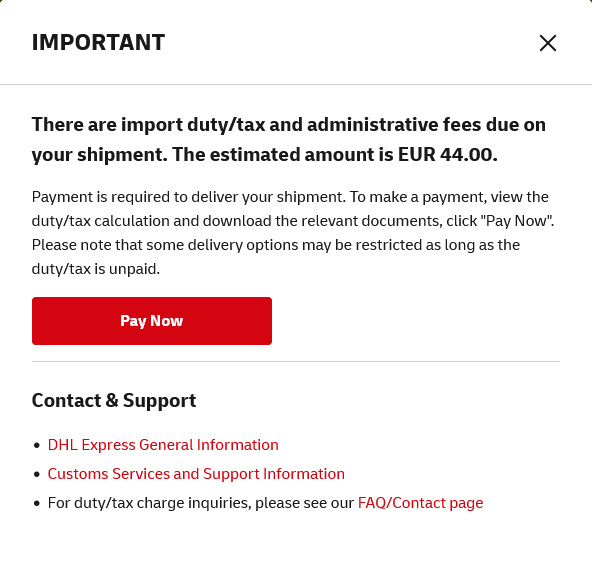
For a self-called premium international express service, such an attitude raises another straightforward operational-governance question: How can a customer be expected to settle a disputed charge when the provider has neither explained its composition, nor ensured access to its own payment system ?
A de facto delivery hold, with the customer left without a workable remedy
To resume this case, DHL makes delivery conditional upon payment of an “estimated” €44 charge, without providing an itemized justification despite repeated requests. The recipient is warned that the shipment may be returned, yet even the designated payment portal fails to respond. The customer is effectively placed in an untenable position: pay first and question later, or risk losing access to a shipment for which the transport has already been paid. In this case, even the option to pay proved inaccessible during our attempt.
Whatever the eventual legal validity of the charges, making a DHL delivery conditional on an unexplained payment ask while providing no functioning means to verify or settle it raises serious questions about transparency, proportionality and operational accountability.
What is worse is that to correct DHL’s error concerning the EUR 44 incl. VAT, DHL is now invoking alternative administrative charges of EUR 45 excl. VAT (EUR 54.45 incl. VAT) plus a further EUR 80 excl. VAT (EUR 96.80 incl. VAT), for a total potential additional charge of EUR 151.25 incl. VAT; even though the customer is not responsible for DHL’s errors and all requested documents were duly provided.
14 October 2026, 20:58 CEST — Status: unresolved — Further update: the human cost of a €44 payment demand by DHL
The consequences of this DHL shipment have now extended well beyond delayed delivery and disputed customs charges.
The recipient in Belgium is nearly 80 years old. According to his account, he received a WhatsApp message, an SMS, and several real person calls from someone presenting themselves as DHL, asking whether he would pay the additional charges and warning that the shipment could otherwise be returned to Switzerland. We have not independently authenticated the caller. DHL’s written payment notification, however, separately confirms the warning of a possible return.
The recipient became so concerned that the payment request might be fraudulent that he went to his bank. He could not understand why two used apartment keys, sent after a family bereavement, would generate an additional €44 demand without a detailed explanation. Eventually, despite his concerns, the recipient was prepared to pay simply to recover the keys. Yet DHL’s designated payment portal timed out, leaving him unable even to comply with the payment demand.
How did an international express courier like DHL managed to frighten an elderly recipient, occupy a bereaved family for days and threaten to return two household keys, without first providing a verifiable explanation of the charges being demanded ?
15 October 2026, 7:09 CEST to 10:26 CEST — Status: unresolved — Further update: an online sale duty fee instead of personal effects. We paid just to unblock the delivery. But the envelope is still blocked waiting for … a payment already done.
After four days without delivery, the family finally paid the disputed EUR 44 solely to recover the keys and prevent their return. Total cost had now risen from CHF 84.65 to approximately CHF 126, credit card charges included. And after payment ? Still no delivery by DHL. The shipment still appears blocked, despite DHL having received the additional amount it made a condition of delivery.
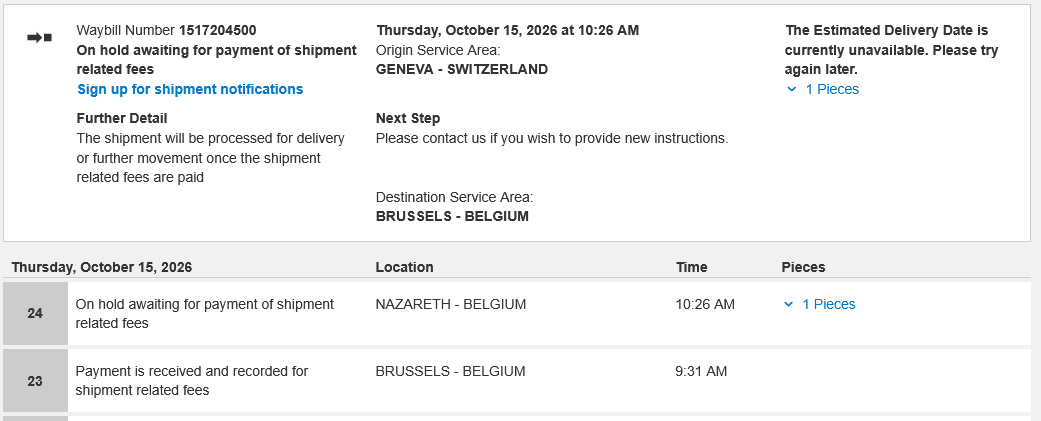
So the situation is now remarkably simple:
- CHF 84.65 paid for “Express” transport.
- EUR 44 more paid under protest to release the shipment.
- Four days later: still no delivery.
At this point, the word Express for DHL appears to describe the collection of additional charges considerably better than the delivery service itself. The sequence raises obvious questions about price transparency, customs compliance and the commercial leverage created when delivery depends on a disputed payment.
15 October 2026, 15:13 CEST — Status: unresolved — still not delivered and justification documents impossible to download from DHL
By 15:13, almost six hours after the EUR 44 payment, DHL had still provided neither a confirmed delivery time nor a clear explanation for the continuing hold. A further call to DHL Switzerland produced no useful information. All is unknown, and a 3rd payment request from DHL looks holding this delivery. The customer is left to connect them and navigate between H7 online sales, and C08 as a private person.
Despite payment of the disputed EUR 44, DHL’s Global Payment Portal does not allow access to the supporting documents allegedly justifying the charge. The download remains blocked on “DOWNLOADING – Please wait while we retrieve the waybill information”. As these documents are only made available for 15 days, DHL looks like it is effectively preventing the customer from accessing time-limited evidence necessary to verify and contest the amount already paid.
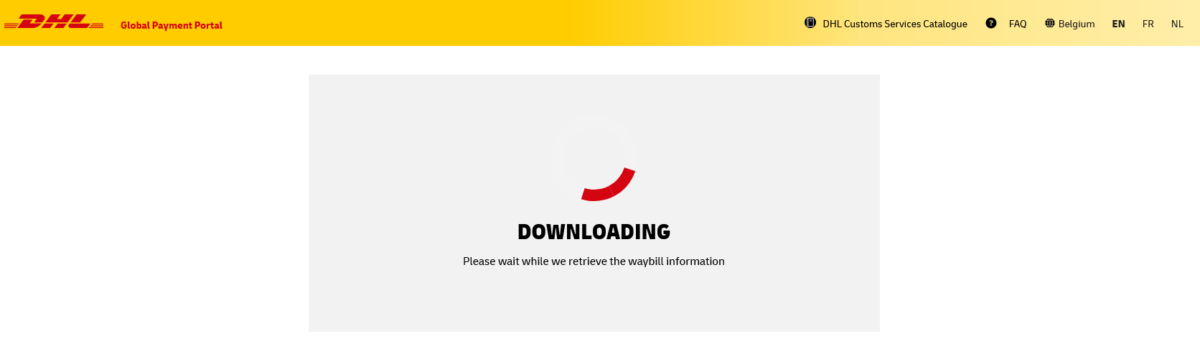
DHL become rather a question: how many times does a customer have to pay before DHL actually delivers ? We already paid twice.
For a company selling speed, reliability and control at a premium price, the experience had become radicalizing: charges and warnings moved immediately; correction and delivery did not. The customer was taken hostage with no alternatives. Such an absurd situation looks so shameful to any decent mind that one would expect an immediate correction. Instead, the DHL customer is met with silence, unjustified delay, procedural indifference and treatment that raises serious questions about fairness and basic commercial standards.
That is why the Belgian Customs, the Swiss SECO and the Swiss Price Supervisor have now been formally informed. At some point, such commercial practices from DHL stops looking like an isolated service failure and starts raising legitimate questions about commercial practices, pricing transparency, accountability and the way DHL handles customers once their property is already inside its network.
15 October 2026, 16:31 CEST — Finally “delivered” and the recipient went to DHL himself
The closure of this DHL Express delivery deserves to be recorded. After four days of delays, disputed customs charges, repeated payment demands, failed explanations and a payment already made to unblock the shipment, the recipient was informed that another delivery attempt would take place on 16 October, sometime between 08:00 and 18:00.
👆🏻
This above.
A ten-hour delivery window.
Nothing less.
Yet another indication of DHL’s lack of operational control over its own logistics.
For a man approaching 80 years old, dealing with the practical consequences of a family death, this effectively meant spending another entire day at home waiting for DHL; and without any certainty that the courier would arrive at the door. Indeed: delivery guys from DHL (and for their defense, other carriers) are well known to skip this step and not deliver.
After everything that had already happened, this 80 years old man decided not to take that risk. Instead, on the evening of 15 October, he got into his car and drove to DHL himself to recover the envelope. So the shipment was finally recorded as delivered at 16:31 on 15 October 2026 but not because DHL Express finally demonstrated impressive last-mile recovery.
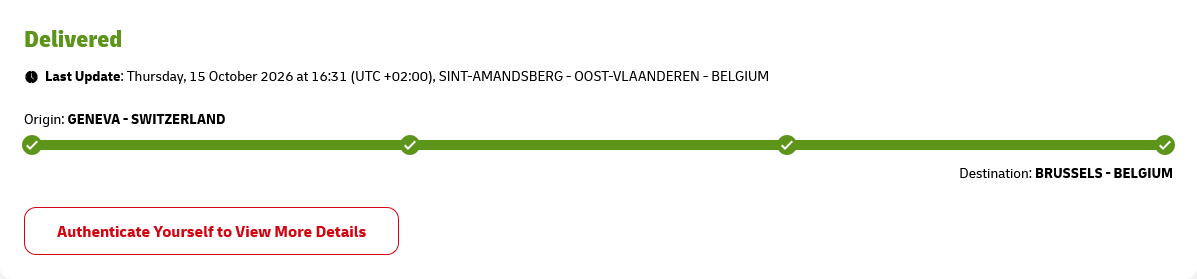
The above “express delivery” took days instead of hours and was ultimately completed only because the recipient drove to DHL and completed the last mile himself. So where, exactly, was the “Express” part ? The service had been sold and scheduled as a roughly 30–36 hour delivery. By comparison, Swiss Post states that Priority consignments within Europe are typically delivered in around 2–3 working days.
In other words, after paying a premium Express price to DHL, absorbing an additional disputed charge and spending days navigating DHL’s internal machinery, the practical result was no better than ordinary postal transit except that the recipient eventually had to collect the shipment himself. So DHL Express is practicing premium, luxury price but with lower postal-speed outcome. And it adds the self-service final mile.
Costs: DHL vs. Swiss Post
DHL charged us CHF 84.65 upfront, and the total amount ultimately paid reached CHF 125.44.
For comparison, Swiss Post currently charges CHF 4.50 to send international small goods up to 100 g within Europe, or CHF 9.50 with PRIORITY Plus tracking. Swiss Post also quotes around two to three working days for ordinary traffic to Belgium. These are not identical products to DHL Express because DHL is presenting its delivery in “hours” and not “days” as the Swiss Post, but the comparison puts the premium into perspective.
- DHL’s original price was therefore almost nine times the tracked Swiss Post small-goods tariff.
- The final CHF 125.44 cost we supported was more than thirteen times that amount.
One may reasonably ask what exactly remained from “DHL Express” beyond the fast billing.
There is something almost elegant about the symmetry of DHL’s business model.
- The DHL customer prepared the correct and full custom documentation.
- The customer investigated itself the disputed charges because DHL presented other custom documents. Why ?
- The customer coordinated DHL Switzerland and DHL Belgium.
- The customer paid the undue additional EUR 44 to unblock the shipment.
- And, in the end, the customer also went to DHL to collect it.
Measured against price, speed, transparency and real delivery performance, DHL Express was not merely disappointing. In this case, it was plainly uncompetitive.
For a premium courier, making an elderly recipient drive to DHL and collect his own shipment after four days of delays is a rather disdainful idea of “delivery.”
But at least the keys finally arrived where they were needed.
DHL later confirmed the delivery and offered to process a reimbursement of the original shipping cost because of the delay. The family has requested reimbursement of the full amount paid in connection with this shipment: CHF 125.44, comprising the original CHF 84.65 transport charge plus the disputed EUR 44 payment, converted at the EUR/CHF rate applicable on 16 October 2026.
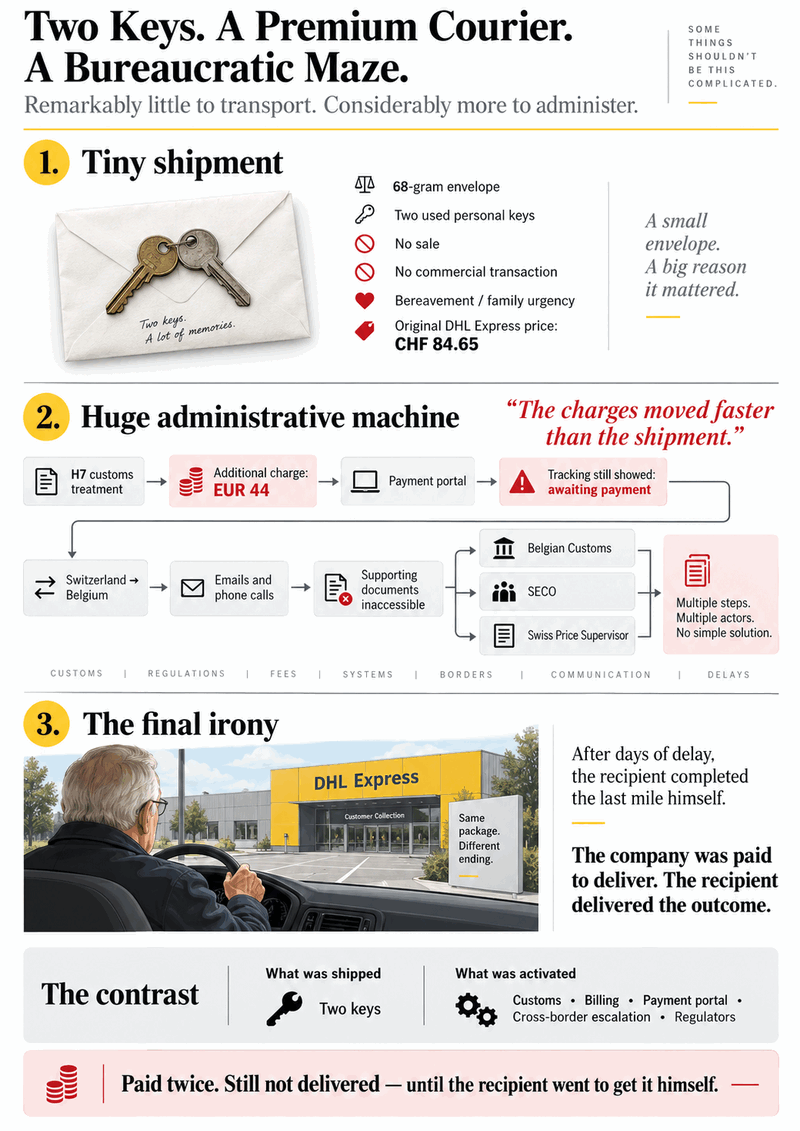
The facts and observations presented here reflect the information available at the time of publication. Subsequent responses from DHL, explanations of the disputed charges, delivery developments, and any outcomes of formal complaints or mediation will be documented as they become available. Updates will be dated and clearly identified to maintain a transparent and verifiable record. Where and if new evidence changes our assessment, the article will be revised accordingly.
The case is not really about two used house keys, transport fees, or undue €44 supplement. It is about what happens when a premium global service encounters an exception and nobody inside the organization appears able to own the outcome.
Editorial status: This update case records DHL’s explanation, the questions that remain unanswered after more than 6 contacts points, and the available complaint mechanisms. Any subsequent invoice, delivery confirmation, cancellation, reimbursement or mediation outcome will be added with its date and supporting evidence.
Sources, case materials and editorial disclosure
Case evidence: Shipping receipt, pro forma documentation, customer-service correspondence and tracking notices retained privately by the family. The shipment identifier, residential details and private contact information are at this stagwe withheld from publication.
- DHL Express, Belgium Service & Rate Guide 2026 (printed pages 20 and 22 for the cited service charges).
- DHL Express Belgium (official service information).
- Belgian Federal Public Service Finance (private-to-private consignments from outside the EU and conditions for exemption).
- Belgian Postal Ombudsman (independent, free complaint and mediation channel following an unresolved complaint to the operator).
Related Debbaut.Solutions reading: When Rules Stop at Documentation · Execution Diagnostic · Projects & Portfolio.
Editorial disclosure: This is a first-person account of a private consumer dispute, interpreted by Elena Debbaut through an execution-governance lens. It is neither a client assignment nor a commissioned or independent audit of DHL; and it is not a legal opinion or a finding of unlawful conduct. Published statements distinguish personal records, official tariff information and analysis. The article will be updated when and if further evidence is available.

Elena Debbaut is a strategic execution expert to boards and executive teams. She leads and advises on complex transformations when governance barriers, internal politics, or structural fragmentation prevent organizations from executing critical decisions.
Specialities:
• governance-constrained transformation
• operational restructuring
• strategic recovery & execution