

Funnel Tracking: Turning Click-Stream Truth into Strategy
Last Updated on 20 November 2026 at 14:22
TL;DR:
- In today’s high-stakes environment, funnel tracking must evolve from marketing vanity metrics to a board-level execution discipline.
- UserFlow360 delivers a GDPR-compliant, Swiss-made telemetry platform that connects raw user events to actionable guard-rails and automated workflows.
- This transforms fragmented insights into enforced accountability, accelerating decision-making and reducing execution latency.
- Leaders gain a single source of truth, linking funnel performance directly to financial outcomes and governance transparency.
Why this matters now. In 2025 the cost of capital is high, the half-life of product advantage is measured in quarters, and boardrooms no longer fund marketing experiments that can’t prove causality. Funnel tracking is not just a dashboard but become a telemetry layer.
This article argues that funnel tracking is no longer a marketing vanity metric but a foundational governance accelerant. By transforming fragmented user behaviour into an auditable telemetry layer, organisations can cut through political fog, align cross-functional teams, and accelerate board-level decision-making.
Data only matters once it funds the next decision.
And yet, most organisations continue to treat funnel analytics as a marketing vanity metric. In reality, a well-instrumented funnel is a governance accelerant: it cuts through political fog, ties DevOps telemetry to EBITDA, and restores decision cadence in under-performing programs.
Leveraging UserFlow360, a 100 % Swiss-made, GDPR-compliant user-behaviour stack with real-time event capture and interactive ApexCharts dashboards , we show in this article how a single telemetry layer realigns technology, operations and strategy.
UserFlow360 is a 100% Swiss-hosted user-behaviour analytics platform, built with privacy by design. No third-party trackers, no SaaS lock-in, and full audit trails — perfect for compliance-driven organisations.
Table of Contents
1 • The strategic thesis — why funnels belong on the board agenda
Conversion funnels are living process models. They start as a hypothesis in Product, mature into a cost centre in Finance, and eventually land on the CEO’s desk as a make-or-break trajectory. Instrumentation is therefore not a “MarTech add-on” but more like a governance ligament of the infrastructure.
Most organisations still run on some lagging GA4 snapshots produced by some junior people — weekly decks rich in colour and images, but quite poor in causality. In practice, such data lives in silos, and board narrative is shaped by the loudest function, not by evidence. Indeed: the darling myth is that funnels are a marketing gadget. However, such funnels expose the friction that erodes strategic intent long before quarterly numbers are decreasing.
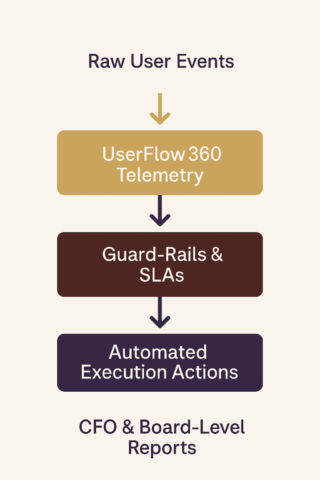
Visual schematic of data processing layers in the Execution Framework™.
In one board meeting, I asked, ‘Where precisely is our growth leaking ?’ The response was the typical cycle of buzzwords — awareness, consideration, intent, pipeline acceleration — none of which translated into actionable insights under tight deadlines and constrained budgets.
I pull up a UserFlow360 and started to analyse a week real traffic. In one dashboard it shows a 38 % abandonment cliff between pricing-configure and checkout-init — the exact fracture no one had quantified in the marketing & sales strategy. The CEO sat forward, intrigued. The CFO reviewed the financial implications quietly. We have just moved from candle-light to night-vision with a fast-implementation tool.
For example, a global FMCG client reduced checkout abandonment by 38% within six weeks of implementing UserFlow360 — turning hidden funnel leaks into immediate revenue gains. Such rapid, measurable impact is why UserFlow360 is trusted by enterprise leaders managing complex portfolios under tight compliance regimes. You can check more Insights and Case Studies on our Labs website.
UserFlow360 is a tool that link browser events to board decisions. This B2B solution is purpose-built to replace fragmented marketing stacks with a unified, privacy-first funnel telemetry platform, eliminating blind spots and compliance risks.
Why funnels escaped the board agenda — until now
- Datapoint inflation. Classic dashboards measured too many vanity metrics; so boards tuned out.
- MarTech bloat. 19 overlapping SaaS tools masked root causes instead of exposing them.
- Privacy panic. Third-party cookies died; most SaaS trackers became compliance debt.
UserFlow360 was engineered in direct defiance of those pathologies: all on-prem or Swiss-cloud, zero third-party cookies, and instant sessions replay for better UX intelligence.
Define the funnel as a strategic asset
A funnel is a living process model — from impression to revenue recognition. When coded correctly, each step becomes a leverage point you can price, fund, or de-scope. Yet, most organizations still treat analytics as reactive reports, lacking a unified model to tie front-end events to financial outcomes.
When I ran my first marketing turnaround program, product and marketing fought over “ownership” of the funnel. We solved it by pricing each stage in budgetary terms and assigning P&L accountability; and then, arguments vanished overnight.
- Awareness → Consideration: brand spend vs. qualified traffic.
- Consideration → Activation: product promise vs. UX friction.
- Activation → Revenue: pricing logic vs. value perception.
- Revenue → Expansion: retention economics vs. support cost.
Track the percent delta between stages (stage-to-stage yield). Yields are strategy health signals: when Y₂ − Y₁ hits a trigger threshold, you have an execution blocker — budget, governance, or tech.
2 • Technical Backbone — Inside UserFlow360
Every metric-savvy business draws the same diagram: Awareness → Interest → Consideration → Conversion → Loyalty. What usually goes missing is the connective tissue that proves each hand-off actually happened.
UserFlow360 acts as that connective layer. Instead of another dashboard, it is a real-time reconciliation service that keeps your marketing strategy, go-to-market operations, and enabling technology in permanent sync—so the promise of every funnel stage holds up under boardroom scrutiny. Under the hood, funnels are event streams. The engineering trick is to cut latency and preserve data discipline without suffocating existing teams.
Acquisition: Turning Unknowns into Known Opportunities
CMOs need to know which channels spark qualified attention, not just a number of clicks.
How UserFlow360 helps ?
- Unified Identity. Graph aligns ad-platform IDs, web cookies, and CRM leads into a single “prospect passport.”
- Source-of-Truth. Attribution assigns weighted credit across first touch, last touch, and everything in between—visible in whichever BI tool finance already trusts.
- Under the hood (briefly). A mix of server-side event collectors and consent-aware pixels streams data through our normalization layer — no client-side code rewrites, no SaaS vendor lock-in.
Activation: The “Aha” Moment On Schedule
In practice, speed matters: a 24-hour delay between sign-up and first success correlates with 2× higher churn three months later.
How UserFlow360 helps ? Product and Marketing stop debating “whose metric is it?” — they both own Time-to-Value, and the system surfaces blockers instantly.
- Real-time alerts when a cohort drifts beyond your activation SLA.
- Automated push to Product board or Jira to nudge UX or onboarding teams.
- Suggested playbooks (in-app tours, concierge onboarding) pre-filled with segment metadata.
Engagement & Expansion: Keeping the Middle of the Funnel Elastic
Most funnels ignore what happens between first value and renewal, leaving upsell dollars on the table.
How UserFlow360 helps ?
- Behavioral Scoring tracks feature depth, frequency, and seasonality to flag expansion-ready accounts.
- Revenue-Weighted Segment Explorer lets RevOps slice usage patterns by ARR tier, highlighting where Customer Success should focus advocacy programs.
- A single toggle surfaces “Expansion Pipeline Gap,” translating product telemetry into sales-speak without exposing proprietary models.
Conversion: Bridging Data & Dollars
Forecast accuracy collapses when funnel math is scattered across spreadsheets.
How UserFlow360 helps ?
- Syncs opportunity stages to the corporate CRM and back-propagates closed-won signals to paid-media bids within minutes.
- Generates Board-Ready Confidence Intervals on MRR projection, factoring pipeline velocity and win-rate variance — no manual VLOOKUPs in Excel is required.
Loyalty & Advocacy: The Self-Refilling Funnel
Retention is cheaper than acquisition, but only if the feedback loop is tight. Marketing can prove CAC payback extends past first renewal, and Product gains a live catalog of customer champions ready for case studies.
How UserFlow360 helps ?
- Early-Warning Churn Radar — that combines usage decay and support-ticket sentiment into an at-risk score, delivered to CSM Slack channels.
- Advocacy Trigger — detects power users, then fires NPS surveys or “Refer a Friend” campaigns through your existing marketing automation platform.
3 • Operationalising Funnel Intelligence
Too many teams congratulate themselves for having a “full-funnel view,” but revenue doesn’t move until someone acts on that view. Funnel Intelligence only earns its keep when it changes the way the next email is written, the next sprint is scoped, or the next budget line is approved. Operationalising means translating analytics into role-specific next steps with an owner, a deadline, and a measurable lift.
Once a funnel feedback loop is proven at product or business-unit level, the next challenge is scaling governance across the enterprise. We’ll explore this process in the dedicated section ‘Scaling Funnel Governance — From Pilot Loops to Enterprise DNA.
Operationalising funnel intelligence is less about algorithms and more about accountability at scale.
True funnel intelligence is less a technical capability than a discipline of execution. It turns fragmented telemetry into cross-functional commitments, binds those commitments to decision rights, and verifies the outcome in the same motion.
Tools such as UserFlow360 supply the instrumentation — yet the hard work lies in translating signal into enforceable governance events that survive board scrutiny and quarterly volatility alike. The following deep-dive dissects five pillars that transform “more data” into operational muscle.
A. From Attribution to Accountability
Most attribution models stop once credit is awarded. In governance-constrained environments that is precisely the wrong point to pause; a hand-off without shared accountability decays before the next sprint ends. Each funnel transition must therefore become a co-signed commitment between origin and destination functions.
Example. When a lead crosses the threshold from Marketing Qualified to Sales Accepted, UserFlow360 records the binary state change, attaches the originating campaign metadata, and prompts simultaneous confirmation from Growth and SDR (sales development representative) leads. Until both approve, the lead remains in a liminal “under review” stage — visible, timestamped, and therefore awkward to ignore. Accountability ceases to be a philosophical argument and become documented latency.
Strategically, this dual-sign model surfaces execution gaps faster than any retrospective. The conversation can shift from who dropped the ball to which guard-rail prevented an unsound pass-through — a far healthier frame for organisations where reputational stakes outweigh quarterly volume.
B. Diagnosing Funnel Paralysis
Pipelines seldom break at the top or the bottom; they stall in the middle where ownership blurs and decision latency compounds. UserFlow360 quantifies that latency directly: every stage carries a default “time-in-state” service level. Breach the threshold and the platform escalates, not to the over-worked stage owner, but to the gatekeeper empowered to unblock — often a VP who signs budget or releases product bandwidth.
Consider a FinTech scale-up in soft-lockdown mode after regulatory scrutiny. MQLs (marketing qualified leads) converted briskly, yet the “Opportunity Queue” ballooned. By surfacing a median 17-day stagnation in the SQL (sales qualified lead) state versus a five-day SLA, UserFlow360 triggered an executive review that re-allocated compliance resources and cleared the backlog inside a week. No additional media spend, no new enablement decks: just visibility into the drag coefficient that had gone unnoticed because “things looked fine in aggregate.”
The lesson: latency is an execution cost invisible to traditional velocity dashboards. When measured and escalated systematically, it becomes a programmable risk rather than an entrenched cultural flaw.
C. Intelligence as a Narrative Weapon
Data rarely fails on volume but on persuasion. Funnel intelligence must therefore feed a political narrative that survives the weekly all-hands. Each month, UserFlow360 compiles a tri-part “Funnel Stories” brief:
- Signal. A statistically significant deviation — e.g., demo-to-SQL conversion slid from 27 % to 21 %.
- Missed Opportunity. Estimated revenue leakage framed in CFO language.
- Team Fix. The squad that intervened, the playbook applied, and the measured recovery.
These briefs travel beyond dashboards. They anchor town-hall discussions, shape board packets and budgets, and re-align incentive structures. By narrating both failure and resolution, the organisation institutionalises learning instead of pathologising error. UserFlow360 supplies the forensic evidence while leadership supplies the ressources and budgets. Together, they turn raw telemetry into institutional memory.
D. Execution Integrity by Design
Visibility without carved-out decision rights devolves into slacktivism — that means a situation when everyone “monitors” data but no one acts. UserFlow360 addresses this situation through role-aware intelligence routing. Each alert, metric, or automation is mapped to execution privileges mirrored in corporate IAM (Identity and Access Management). Sales may pause under-performing ad sets, but cannot alter churn-risk thresholds; Product may toggle feature flags, but cannot spin up experimental paid campaigns.
Every intervention writes an immutable audit log: actor, context, payload, reversal window. Regulators see provenance, auditors see segregation of duties, engineers see a clean web-hook trail. Execution integrity moves from aspiration to artefact.
Internally, the practice forces a cultural shift: teams lobby for expanded rights only after demonstrating process maturity. Governance becomes iterative.
E. Feedback-Loop Maturity as Competitive Advantage
Operating loops mature along four rungs.
UserFlow360 accelerates the climb. A RevOps analyst can publish a new guard-rail as a four-line SQL view, check it into Git, and deploy via UI (user interface). The heavy infrastructure like the event capture, stream processing, security remains abstracted. Experimentation costs trend to zero, while institutional agility becomes visible: how many loops run at Level 2 or higher this quarter, and what percentage of revenue passes through them ?
Boards invested in operational leverage recognise such metrics instantly; it isolates scalable process from heroics. In geopolitical climates where capital shies away from execution risk, high loop maturity becomes as valuable as a differentiated product roadmap.
| Level | Dominant Characteristic | Consequence |
|---|---|---|
| 0 – Passive Dashboards | Metrics displayed, seldom acted upon | Reactive firefighting |
| 1 – Manual Tagging | Ad-hoc notes and exports | Inconsistent follow-through |
| 2 – Automated Loop | Alert → Action → Verification | Predictable remediation |
| 3 – Learning Loop | Loop data feeds next-cycle planning | Compounding efficiency |
Funnels may begin as marketing artefacts, yet in governance-heavy organisations they evolve into living protocols of execution. Tools like UserFlow360 expose blind spots within those protocols, assign ownership, and verify compliance in a single flow. Once intelligence becomes enforceable accountability, growth stops resembling a quarterly gamble and starts behaving like a managed asset — auditable, forecastable, and compounding. Tools facilitate, but only leadership can insist that every insight earns its keep in the next budget cycle.
Scaling Funnel Governance — From Pilot Loops to Enterprise DNA
Scaling funnel governance is about a systems-engineering exercise for decision-making. It aligns domain autonomy with portfolio oversight, embeds guard-rails where work actually happens, and turns every closed loop into a repeatable asset. UserFlow360 supplies the observability and control plane while leadership supplies the insistence that no metric escape an owner, no owner escape a deadline, and no remedy escape documentation.
Achieve that, and funnel governance migrates from pilot curiosity to enterprise DNA: auditable, forecastable, and capable of compounding value quarter after quarter.
Scaling funnel governance is not always a BI (business intelligence) initiative. In practice, it is operational alignment across Product, Sales, Marketing, Success, and Finance. UserFlow360 enables this by:
- Enforcing standardised execution structures
- Reducing time-to-action
- Making accountability traceable
- Giving the C-suite a reliable view of funnel maturity — tied to revenue
Before scaling anything, a company need to lock your funnel semantics inside a controlled system where:
- Each funnel stage (e.g. MQL, SQL, Activated User, Expansion Candidate) is versioned
- Criteria are defined in functional terms — not system-specific fields
- Each stage has a domain owner (e.g. Marketing Ops, Product Ops)
In UserFlow360, those options can be integrated. Stage definitions are centrally governed, but domain-specific implementations (per product or region) are layered on top — not hardcoded. For instance, if Marketing wants to adapt the lead score threshold in the German market, the governance dashboard flags the delta and notifies the Funnel Committee. Indeed: without control over funnel semantics, comparisons across units are meaningless and decision latency goes unreported.
Why Scaling Fails Quietly
Funnels do not break from a lack of ideas. They break when execution logic is not standardised across teams, markets, or systems. What starts as a working feedback loop in one product or BU quickly becomes a silent failure at scale:
- Different teams define stages differently
- Latency creeps in because no one owns time-in-stage
- Interventions are discussed, not executed
- Governance dissolves into dashboard rituals
UserFlow360 was built to address such issues — not with another reporting layer, but by formalising how funnel governance is embedded into execution: cross-functionally, measurably, and with enforceable response paths.
Indeed: scaling governance isn’t about having KPIs or more dashboards — it’s about turning deviations into enforceable workflows and remediation paths. UserFlow360 lets you define operational guard-rails on any funnel metric, such as:
- “Demo-WebPage-to-SQL rate drops below 22% for more than 5 days”
- “Time in activation stage exceeds 72 hours for more than 30% of users”
- “No user logged in after signup in past 48h”
Each guard-rail is tied to:
- A responsible function (execution owner)
- An escalation timeout
- An approved response protocol (e.g. trigger onboarding campaign, flag UX review)
From Loop to Enterprise Data Mesh
A single closed loop proves the concept; three establish a pattern; beyond that, governance must evolve from local reflex to system design. At scale, funnel feedback loops belong in an enterprise data mesh — a distributed yet standardised architecture where each domain owns its telemetry but abides by common contracts: stage definitions, SLA targets, escalation paths.
UserFlow360 operates as the mesh’s federated observability layer. In practice, Marketing in Frankfurt and Product in Singapore retain their local schemas, yet map critical fields (e.g., MQL, Activation Event) to a shared catalogue. This ensures every deviation triggers comparable remediation logic, no matter the region or product line.
Mesh adoption also demands cross-functional operating committees. They approve schema updates, arbitrate guard-rail changes, and resolve conflicts before they calcify. The objective is coherence without central bottlenecks: local agility, global standards. Their remit is not to slow momentum; it is to ensure that a local optimisation never fractures the global model.
Link Alerts to Role-Based Execution Paths
In UserFlow360, alerts are real-time operational signals triggered by deviations from defined funnel expectations — such as stage conversion drops, time-in-stage overruns, or usage anomalies. They are not generic notifications. Each alert can be configured with:
- a precise threshold (e.g. activation rate < 30% for 48h),
- a designated owner (function or role with authority),
- and a pre-approved action path (e.g. create ticket, trigger campaign, escalate to exec).
Alerts only change behaviour when they land with the right person, in the right format, with the right authority to act. UserFlow360 routes funnel alerts based on your process matrix, such in the following example.
| Alert Type | Owner | Routed To |
|---|---|---|
| MQL volume drop | Marketing Ops | Slack + Email + CRM lead tagging |
| Product activation delay | Product Lead | Jira backlog + optional flag in heatmap |
| Churn-risk re-entry | Customer Success | CRM + internal notes for AM |
UserFlow360 can also track the coverage ratio: % of ARR (annual recurring revenue) passing through governed funnel stages. This is how it can justify progress to Finance or the Board. In practice, a company cannot scale everything at once, but applying a model governance in layers, as following.
| Layer | Description | Example |
|---|---|---|
| 1 – Core Funnel | Acquisition + Activation | Lead intake, onboarding, activation time |
| 2 – Retention | Post-onboarding usage loops | Drop-off detection, early churn triggers |
| 3 – Expansion | Expansion moments | Seat growth, feature adoption, ARR scaling |
| 4 – Advocacy | Referrals, NPS logic | User champion signals, review prompts |
UserFlow360 is more than an analytics suite. For enterprise implementations, it can be a strong MarTech governance interface. Every element in the funnel — stages, metrics, alerts, actions — is tied to a real person or function within the organization. Such an approach builds governance accountability into the tooling layer, not as an afterthought in slide decks.
- Domain stewards approve and maintain local adaptations
- Funnel Committee sees exceptions, change requests, and long-tail anomalies
- Executive leadership receives impact reporting tied to business outcomes
Boards don’t want more metrics, dashboards, or MarTech tools. They want to know:
- Where is execution solid ?
- Where are handovers failing ?
- How many business units are flying blind ?
For enterprises, UserFlow360 ships with a Funnel Governance Scorecard, including:
| Metric | Description |
|---|---|
| Execution Coverage | % of revenue governed by SLAs |
| Median Stage Latency | Time spent in each stage before action |
| SLA Compliance | % of alerts resolved within defined window |
| Resolution Ownership | % of alerts with confirmed execution path |
Frequently Asked Questions about Funnel Tracking with UserFlow360
- Will UserFlow360 replace my existing BI stack ?
- UserFlow360 complements your BI tools by providing a governance-grade telemetry layer focused on funnel execution. It standardizes event data, enforces guard-rails, and automates alerts, feeding clean, actionable insights into your BI dashboards.
- How long does deployment take ?
- Typical instrumentation and initial guard-rail setup takes 30 days. Full operational maturity depends on your organisational scale and governance cadence but can accelerate with our 30-Day Funnel Sprint program.
- How is personally identifiable information (PII) treated ?
- UserFlow360 is designed with privacy-first principles. PII is masked or anonymized at collection, stored encrypted on Swiss-hosted infrastructure, and access is tightly controlled via role-based permissions to ensure GDPR compliance.
Take-Aways
Funnel tracking is not MarTech plumbing; it is execution telemetry that lets leadership steer capital, de-risk releases, and compress decision loops. With tools like UserFlow360 you can own the data, keep regulators happy, and turn click-stream truth into profit-and-loss reality.
Funnels are not dashboards; they are execution telemetry. Treat them as living covenants between capital and code. With UserFlow360 you can surface truth at the speed of spend, satisfy regulators, and fund decisions that keep your growth story credible.
Frequently Asked Questions about Funnel Tracking with UserFlow360
- Will UserFlow360 replace my existing BI stack ?
- UserFlow360 complements your BI tools by providing a governance-grade telemetry layer focused on funnel execution. It standardizes event data, enforces guard-rails, and automates alerts, feeding clean, actionable insights into your BI dashboards.
- How long does deployment take ?
- Typical instrumentation and initial guard-rail setup takes 30 days. Full operational maturity depends on your organisational scale and governance cadence but can accelerate with our 30-Day Funnel Sprint program.
- How is personally identifiable information (PII) treated ?
- UserFlow360 is designed with privacy-first principles. PII is masked or anonymized at collection, stored encrypted on Swiss-hosted infrastructure, and access is tightly controlled via role-based permissions to ensure GDPR compliance.
█ Ready to Turn Funnel Telemetry into Board-Level Results ?
Dive deeper into the Executive Overview for strategic context, review the Engineering decisions behind our self-hosted stack, see how the platform scales in real-world Implementations, and scan industry-specific results in the Case Study Section.
to restore delivery logic and unlock scale.
Book a discovery call to identify failure points, reset priorities, and define first corrective actions.
Next step: run the 30-day instrumentation sprint (template available on request) or schedule a confidential funnel audit with Debbaut.Solutions.

Elena Debbaut is a strategic execution expert to boards and executive teams. She leads and advises on complex transformations when governance barriers, internal politics, or structural fragmentation prevent organizations from executing critical decisions.
Specialities:
• governance-constrained transformation
• operational restructuring
• strategic recovery & execution