

〈checklists〉 Key elements for creating an effective business continuity plan during a crisis management program

Last Updated on 12 May 2025 at 11:07
This publication reviews the essential elements for creating a realistic continuity plan before and during a crisis.
The solid practical checklists and summaries may support the preliminary analysis of a business continuity plan and the first 50 days of management during the crisis. These observations can meet the needs of many companies and companies and fields of activity.

This book’s practical advice allows companies to adapt and create a strategy that suits the new requirements and business context. The practical guidance is drawn from observations in the field with various types of businesses and help reduce operational risks during a crisis.
The management of disaster recovery should be part of business continuity planning. This critical plan should clarify the essential risks and issues that will ultimately help reshape its operations during and after the crisis. This first version of this publication does not cover the entirety of such a vast and complex subject but offers an entrepreneurial and practical approach.
Crisis Management in one question and a short answer
Question:
When creating a continuity plan that works effectively in a crisis, you must consider several key steps. Can you tell me more about those steps ?
Answer:
During the crisis period related to the COVID-19 pandemic, many businesses suffered tremendous financial and operational losses. In the absence of a continuity plan, these businesses are closing their doors. A continuity plan is still an important aspect of business management for all types of companies.
The need for a business continuity plan increases progressively according to various criteria such as the size of the company, its business objectives, its geographical area, or sector of activity.
Thus, in absolute terms, small structures such as freelancers may have a greater need for a continuity plan than small companies with a few dozen employees. In this case, small firms are much more impacted than large companies with emergency funds or can afford the operational and financial losses related to a few days delay. A freelancer does not have this luxury.
At the same time, as the size of the company increases, the negative impact of a crisis and the financial losses are greater. Such a company absolutely must have a business continuity plan to minimise its operations and profits.
Managing the recovery of current operations after a disaster must be part of the business continuity planning. This essential plan must clarify the critical risks and issues that will ultimately help reshape its operations during and after the crisis.
Preliminary Analysis
To begin with, and before any crisis, I recommend immediately and simultaneously launching these three actions that you can briefly see in the following infographic (fig. 1 – actions during a crisis management mandate). Remember that crisis managers must fully deploy the business continuity plan in just a few days, not in a few weeks.
Indeed, during a crisis, such a plan must also have the ability to adapt according to ‘Agile’ working methods.

download the .pdf version of this business infographic
A. Strategic Alignment
Align your management team with the crisis management strategy, and don’t underestimate the signs that indicate a potential crisis. As a company, do not underestimate the dangers of an emergency.
The management team, even at the senior level, often has a tendency to underestimate the signs of a crisis. Avoid inaction because in a crisis, a wait-and-see attitude could seriously damage the company.
So make sure that the whole team is informed and aware of the actual severity of the macro-economic situation. The worst financials can become a reality during a crisis, and proactive measures will need to conserve cash and reduce expenses based on criteria previously established in your business continuity plan.
The number one priority is to keep the cash flow that allows you to survive and adapt your strategy.
B. Task Force
Proactively seek the services or advice of a professional task force, especially if there is no such in-house capability.
As a high-level administration, your strategy implementation must proactively build an experienced, full-time senior-level team for crisis management. A few in-house consulting sessions on an ad-hoc or regular basis can help create a framework that stands the test of time, especially when internal information and skills are disparate. Ideally, this Task Force type team will have had experience in your industry and will also have practical skills in many disciplines such as operations management, sales and marketing, human resources management, financial management, and most importantly, technology.
Ideally, the crisis manager and head of the steering committee should master at least 2-3 disciplines that are essential to the company. The business management or its board should make this choice in full knowledge of the facts, preferably by an internal expert or a third party from a trusted consultancy firm.
Always prioritise and optimise the main workflows. Keep in mind that during a crisis, the ‘Agile’ approach is of the highest importance. The day-to-day operations in your company must always be prepared for such an exceptional situation. Problems arise when highly hierarchical companies have strict habits of managing operations, processes, and reporting.
However, such an operational model will be ineffective during an emergency if only for faster, informally, and directly reporting to the upper management. A monitoring tool such as a centralised information system could be of great help, and not only during a crisis.
C. Scenarios and contingency plans
Describe the most likely general strategic action scenarios, with the inclusion of a well-developed business continuity plan, and plan for multiple contingency plans for various situations and functions impacted during the crisis.
Ideally, strategic action scenarios should be organised by geographic area, and then by function.
These scenarios must concretely anticipate the likely decline in revenues and operational disruptions. Start proactively, even with the most unlikely scenarios in mind, such as the events of a pandemic that may occur every 100 years. Think big, even if it means using emergency funds as a competitive advantage. The chapter with the practical checklists offers you leads often forgotten in the field, and can help you create a good emergency action plan.
Introduction to the Task Force methodology
In the following chapters of this advanced level publication, I will present my field practice and the essential steps to help better all companies form their business continuity plan. Such a plan will help create business resilience during times of crisis and a successful rebound from operational and strategic disruption.
Creating an effective business continuity plan requires time and money and a great deal of operational experience, and, above all, an almost perfect knowledge of current operations and workflows. Industry experience is therefore essential.
Unfortunately, the company’s managers do not always know the reality of the field. The concept of “running the business” is the responsibility of a few executives and managers, impacting the quality and effectiveness of an efficient and immediately applicable continuity plan.
In my experience with crises management, companies too often operate on a day-to-day basis without any vision. A business continuity plan must be robust to consider all its essential functions and help it carry out its activities. At the same time, the notion of “change the business”, i.e. the company’s strategic change, must also be integrated into such a continuity plan because crises often offer very interesting opportunities, especially in the faster creation of services and products.
Here are the essential steps to formulate an effective plan to help you successfully navigate most crises and emergencies. This plan will allow operations teams to ensure business continuity without creating it urgently during a crisis.
Indeed, during a crisis, the situation is already tense. The absence of such a plan will add further stress to creating such crisis management and define actions’ strategy on the spot, further delaying the resumption of current operations and possible strategic changes.
I. The main steps in creating your business continuity plan
The Business Continuity Plan (BCP) is an operational method for anticipating business risks and reacting quickly in a crisis.
This plan ensures that most employees on critical functions and the most important assets are protected, and that day-to-day business operations can continue without significant interruption in a crisis. Here are the main steps for creating your continuity plan.
I.1 Identification of the objectives of the continuity plan
Business continuity management in a company usually goes beyond the IT department. This plan applies to all business functions such as human resources, product development, sales and marketing, operations, public relations, and many others. It is important to identify the goals and objectives of the company before the crisis.
An experienced person should perform this preliminary analysis and actions to help formulate an effective business continuity plan. Such a plan will allow current operations to continue while minimising the recovery process and reducing disruption to the business. Identifying business objectives will help assess risk, which will allow for the creation of quickly effective recovery strategies in a crisis.
I.2 Setting up a specialised task force for crises
As a company, it is essential to find the right people for the task force team and to be able to reduce operational and strategic risks in the event of a crisis. The composition of the task force team is important, as the success of the business continuity plan depends heavily on its operational skills and field expertise.
Therefore, select people who already have some operational experience, leaders who can make the right decisions quickly, versatile people, and anyone who can be useful through their interactions. Also, make sure that several real leaders create the plan and implement it during crisis management. It is better to test crisis management skills before such a situation occurs.
The Task Force type team is responsible for moving things forward while making important decisions when necessary.
I.3. Correctly measure potential risks and their impact on operations
The risk assessment is one of the crucial parts of the business continuity plan that will include all possible risks that a company may face when going through emergencies.
Depending on the risks’ nature and type, crisis managers will run the business continuity plan (BCP) in such a way as to create a real impact on the smooth running of the company’s operations during the disaster. Correctly identifying potential risks and threats to your business and analysing them will help you modify, reduce or add essential services in the continuity plan.
Crisis managers must properly document any action allowing to examine the impact on the business operations and strategy.
I.4. Identification of essential functions
Identifying critical services and functions is a very important step in creating a business continuity plan. The essential parts and business operations that crisis managers will include in the continuity plan will be the services that will help your business run smoothly during a crisis. These services can cover areas such as sales, commercial and technical customer support, marketing operations, IT development, or purely financial aspects.
The core functions of a business are dependent on the nature and scope of the company. The mandatory business functions can include order processing, shipping times accurate estimates, inventory management, supply chain management, e-commerce platform functionality, and customer service.
I.5. Proactive and comprehensive analysis of critical business functions
The person or team responsible should include a proactive and comprehensive analysis of business functions when creating a business continuity plan. It would be best if your business managers could plan every essential function of the company to operate at full capacity during a crisis. Critical business functions must have a clear identification and respond with sufficient operational and financial resources.
The business continuity plan should also include the precise way to identify the warning signs of a crisis and, most importantly, the exact moment when you should hand over the reins to your task force team.
Such a transfer process is essential to ensure that customers receive the agreed products or services while keeping production, inventory and the supply chain intact. Depending on the company’s size and its sector of activity, each department or function of your company must have an alternative plan in a crisis. Identifying risks and their impact on the company is therefore essential to efficiently prepare a business continuity plan.
I.6. Improvement of the business continuity plan
A business continuity plan will never be complete.
You should, therefore, constantly review this plan and make any necessary changes. The business continuity plan should be flexible by nature and adapted to new conditions in your business or the market. In a crisis, the improvements and achievements can avoid the additional stress of adding or deleting something at the last minute.
Because of the strategic nature of such a plan, you need to ensure that it can work properly. You must also ensure that you have documented in detail the steps of your emergency policy in a crisis, with an up-to-date assessment of the company’s risk level, or else, the financial resources that operational managers and strategic leaders can use immediately and outside the usual budgetary definition circuit.
During a crisis, you must also ensure communication with employees or external collaborators and external partners who may work with you during such a situation. You will need to keep in mind that you need to be proactive and maintain these relationships. By formulating the plan in this way, you will help the business run error-free during the disruption with additional and multiple policies and checklists.
I.7. Test and improve according to the experience of operational teams or external task force team
Once a business continuity plan is well-defined, it is very important to present it to the various stakeholders. The members of the operational teams have experience in the field and can also suggest the necessary steps.
Ideally, and depending on the context, your company will need to execute some testing, either with operational teams or with the help and validation of external task force teams.
These actions will assure you that the continuity plan is functional in practice and can cope with disruptions.
It is important to keep your teams informed about changes and improvements to the continuity plan, especially following the test runs. Crisis managers and leaders must present regular updates and improvements to ensure that the plan works in real life.
II. General checklists for business continuity planning
A well-planned business continuity management plan, both from an operational and strategic standpoint, can help ensure that companies and teams can effectively face a crisis. Indeed, it is increasingly necessary to deal with the growing complexities and threats that can compromise its operations.
Business continuity and disaster recovery are a kind of insurance policy against the threat of natural disasters, political or market disruptions, during or after cyber attacks, or any other situation that impacts a company’s day-to-day operations. The following are the concrete items to be checked as part of the checklists.
Crisis managers and leaders should record that these general lists must adapt to your company’s context, such as its size, sector of activities, and geographical area.
II.1. For the constitution of the team for crisis management or outsourcing to an experienced team
Depending on your business context, the business continuity team implements and executes the business continuity plan. The team identifies the potential events for which it must prepare. During most situations and companies, business continuity management teams can integrate the following roles as part of the Steering Committee during a Crisis Situation.
• Senior Management / Executive Sponsor
• Business Continuity Manager (BCM)
• Main suppliers and vendors
• Team leaders for specific tasks, or managers of critical departments such as:
◦ Administration / Risk Management
◦ Customer Services / Help Desk
◦ Technicians for external field installations
◦ In-house Support and Coordination Technicians
◦ Responsible for internal/external communications during the crisis period
◦ Responsible for Information Technology
◦ Responsible for Human Resources (HR)
◦ Head of Operations / Logistics
These individuals will proactively prepare the standards for the continuity plan, train other senior members of the team, and identify the processes to ensure the business continuity plan is well-executed. As a general rule, the executive-level business continuity team should include at least one representative from each major department. Depending on the size of the company, its sector of activity and its geographical area, it is useful to add additional people such as Region Managers and distribute responsibilities accordingly.
II.2. For the business impact analysis
A business impact analysis (BIA) supports the entire continuity process. This analysis must identify, quantify and qualify the impact of a financial or operational loss, a temporary or longer interruption, or a disruption of current operations. The business impact analysis helps organisations identify mission-critical activities and the timeframe for crisis managers to restore them.
Business leaders and crisis managers should consider external factors such as the company’s suppliers. The crisis management team should also consider alternatives to reduce critical dependencies on suppliers who can negatively impact a crisis.
II.3. For risk reduction
Following the business impact analysis, the company must mitigate risks that can potentially threaten both the health and safety of employees and collaborators, as well as the conduct of current operations or the company’s assets.
Total elimination of risk is not possible in many crises, but it is possible to reduce the risk to an acceptable and manageable level by internal or external task force teams.
Risk reduction strategies may include the following:
• Safety and fire protection systems
• Procedures for minimising or eliminating single points of dependency, such as:
◦ Preliminary analysis and contacts with alternative suppliers
◦ Computer backup strategies
◦ Team building for direct field interventions
◦ Establishing a plan for the distribution of critical functions and resources across multiple sites
• Preventive maintenance programs and proactive testing
• Cross-training of staff and crisis awareness training
• Establish business continuity strategies for:
◦ outsourcing of tasks or processes
◦ policies and procedures for continuity of work in other temporary locations (e.g., home-based sites, shared workspaces outside the company’s premises, mobile offices)
◦ alternative procedures for IT infrastructure during crises (VPN, servers, cybersecurity, data security, communications)
Ideally, strategic leaders should conduct crisis management training for all members of the company with critical roles and missions in the business continuity plan. Remember that this training does not have to be at an advanced expert level, but a few essential modules are sufficient.
In my experience in the practical workshops and crisis management training that I have delivered over the past few years, I have discovered that theory is quite far from the reality on-site and never fully-retained, so we need to move towards practical scenarios and test the effectiveness of the operations plan. Indeed, practical workshops are the best approach for staff and managers who are not experts in crisis management.
As with any plan, regular testing is necessary. A business continuity plan that is outdated or not adapted to the reality of the market and operations will be useless when you need it most. Potential flaws are discovered and corrected during testing periods, even before they cause significant disruption.
Therefore, update the plans on an ongoing basis. Depending on the company, these checks should be carried out annually, ideally during operational budgeting.
A proactive approach to crisis management involves the entire company, regardless of its size.
All business functions and departments must understand the importance of business continuity planning, the roles, risk assessment, budgeting, planning processes and implementation.
III. Actions for the first 50 days of crisis management
Traditional approaches to responding to a crisis are not always sufficient. Because of the hyper-globalised competition, companies have to plan a faster, more experienced, and even aggressive reaction to protect their interests and adapt to the new market needs. A crisis changes a company.
During an emergency, it is always difficult to take a step back. However, the existence of a business continuity plan makes it possible to ensure the continuity of the strategic vision and to use the crisis to improve and transform certain aspects such as the products or services offered, to accelerate the digital transformation of the processes and operations, and how to respond to new market needs. Business transformation during a crisis is very fast at all levels, and with a capacity of innovation increased by external stress.
Don’t forget that there will be a post-crisis period, and the way you manage during the crisis increases the chances of a new and successful re-entry. The following chapter presents concrete actions to be taken during the first 50 days to increase the company’s chances of success and operational and strategic survival.
III. 1. Adapting the strategic vision to new conditions
A crisis involves major disruptions to operations and always affects the strategic vision. This unfortunate situation is why crisis management must anticipate risks as much as possible and work proactively to reduce them.
As a main rule in crisis management, I recommend applying an offensive strategy, not just a defensive one.
As a business leader with crisis management responsibilities, you will have to define how to take advantage of the crisis to outperform your competitors and increase your market share during and after the crisis. Therefore, plan a roadmap for M&A (mergers and acquisitions), investments in new products or services, or any service that creates a sense of familiarity with the customer.
Not lastly, in a crisis, it will also be necessary to plan strategies to rebound and recover through targeted actions and investments in multi-channel marketing, monitoring of macroeconomic trends in society, and also to get the best return from activities with “if … then …” moves. Plan for and take advantage of a radical change in customer behaviour, especially in the digital domain.
The main points of the following general lines can help you design a continuity plan that follows the strategic line of the company but at the same time adapts to new market trends.
1. Worst case scenario
In a crisis, prepare your company for the worst-case scenario that can occur. If the worst-case scenario does not happen, your company already has a competitive advantage and reduces the costs and steps involved in recovery and operations.
It should be kept in mind that a wait-and-see approach is always doomed to failure and significantly impacts its strategic line.
2. Budgetary reserve
The company’s revenues are likely to decrease during a crisis and may even follow an existing negative trend in the market. This negative impact is because the service or product offered may no longer meet the market’s needs. During a crisis, income can even be non-existent, as the last COVID-19 pandemic crisis showed us during the compulsory closures that affected the HORECA marketing sector of the hotel and restaurant industry.
Therefore, it is very important to plan and have a budgetary reserve that can cope with disruptions, ensuring the continuity of operations. Again: the recovery may not be quick, and it will take several quarters of declining income. However, the company’s operations must continue to be carried out promptly during this period.
It is also possible that the company’s services or products will be in high demand in a crisis, but this should be a bonus, not a given.
3. Operational crisis management
Operational management of operations is often underestimated during a crisis, as companies prefer to focus on the pure communication aspect. However, communication alone does not ensure the governance of current business operations. Many companies do not know how to manage the incident after it has occurred, let alone preventively.
The events that lead to crises are quite different in form and nature, so it isn’t easy to know the principles of dealing with them. At the same time, crisis management teams have the methods, expertise, and strategic insight to develop a plan to continue operations. However, the operational aspect remains paramount in the design of such a plan. The following chapter provides more details on the strategic implementation in the field.
The principles of operational management during a crisis cover the following aspects:
3. a) Eliminate the source of the crisis and correct the causes, if possible
It is not always possible to eliminate the source of the problem, and even less so when it is a major crisis such as the one related to the COVID-19 pandemic. Nevertheless, the idea of this principle is to quickly implement some temporary solutions that will stabilise current operations and their recovery.
This principle is more suitable for managing crises such as computer intrusions and attacks, fires or floods, political or economic unrest limited to a small area or a few production units.
When these situations are under poor management or the cause of the problem is not solved at the root level, these situations are more indicative of system instability, a simplistic strategic approach, and poor business management.
Eliminating the source of a crisis will not solve future problems. Indeed, since the cause of the problem is unsolved, then other similar or identical situations may reappear. Numerous companies and organisations remain in a state of almost permanent crisis, with an acceleration of their frequency and negative impact.
The organisation as a whole is unstable and ineffective in managing risks. In this type of situation, crisis management must go through a complete stabilisation of the system.
3. b) Damage control
Although it is contrary, the containment of the damage is the second step. Indeed, if the source of the crisis is not clear at the first stage, then the effects will continue.
Imagine the situation of a flood. In the first step above, crisis managers must identify and correct the flood’s source and cause. The same goes for a fire. In a crisis related to a computer attack, you will have to identify the source first before starting to change passwords or block all accesses to contain the damage. As you can see, this is why rushing to stop the damage rather than understanding and identifying its causes would be counterproductive and even more damaging than doing nothing at all.
For efficient crisis management, the most efficient and interesting human and financial resources actions can succeed when crisis managers identify root causes and consequences. Indeed, damage control has a cost that is not negligible, even when resources are limited, which is often the case during a crisis.
4. Experienced and high-level team in crisis management
Employees, customers, and suppliers are most likely to be afraid or panicky during a crisis.
Uncertainty is never good for business. This kind of guesswork is why a company must immediately reassure its presence with a crisis management team, available full time, every day, seven days a week. The experience of the high-level people chosen to ensure the transition during this period can reassure and limit the snowball effect that occurs during this type of situation.
5. Adjustment to new trends and needs
The company director must also be very active and at the forefront. His strategic actions and corrections ensure stability and adjustment to new trends. These two actions are very aggressive from a strategic point of view and strongly impact daily operations management.
This adjustment to new market trends and customers’ needs is a delicate balance that must be achieved quickly, between “running the business” and “changing the business”. Therefore, the right crisis management team and the right entrepreneurial skills of the business leader are essential to the success of such a challenge.
III. 2. Improve operational aspects
Crisis managers can take several actions to mitigate the impact of a disruption and stabilise the business to establish a new strategic and operational foundation. It will therefore be imperative to develop operational contingency plans for all aspects of the company.
The areas of intervention cover the following:
1. Stabilisation of operations in anticipation of the new normal
A company will first stabilise supply chains against disruptions (political, economic, natural disasters) and major market changes during a crisis management situation. This stabilisation can cover aspects such as:
• Ensure the production of the service or product, distribution, contact with suppliers.
• Secure the physical production facilities.
• Production cost control (equipment, supplies, personnel).
• If applicable, anticipate variations between regions or countries.
• Ensure the security of the head office, IT tools, intellectual property, business processes.
2. Intensive monitoring of financial aspects
A company in a crisis will have to pay special attention to the financial aspects. Thus, the three main lines of intervention are revenues, profits, and monetary analysis of profit and loss accounts.
• Proactive defence against revenue shortfalls
– Adopt a customer-centric view. After all, it is the customer who keeps the business going.
– Build trust, loyalty, and market share during and after the crisis. The business continuity plan will also need specific actions to mitigate the negative effects of revenue declines.
– Focus financial resources on strategies and actions related to present and future growth, even if it means a few new products and services that can be quickly introduced and sold in the market. Stop everything else.
• Urgent cost reduction
– Stop all expenditures that are not directly related to the management of current operations. Take immediate actions such as hiring freeze, eliminating operating expenses not directly related to profits, freeze on investments, and optimising working capital).
– Define aggressive cost reduction actions based on the most extreme and low revenue scenarios. It is better to reduce costs immediately to preserve the company’s liquidity. If the worst-case scenarios come true, this proactive action will save the company. Keep in mind that during a crisis, no idea is bad or too extreme.
– Depending on the type of crisis, apply a medium-term plan that allows for a sustainable reduction in the cost structure, such as non-essential outsourcing, automation of processes, or definitive elimination of functions and roles with little added value for the company.
• Analysis of profit and loss accounts
– Depending on the type of company, its geographical area, its activity field, the crisis management leadership should forecast the prospects for 4 to 20 years, with a 2-year projection.
– Aggressive cash management based on profit and loss accounts. Anticipate macro-level scenarios in the market, and translate them into concrete actions to increase cash flow, focusing on estimating units of products or services to sell, net revenues, operating costs, capital expenditures, working capital, current cash flow.
– Definition of extreme downside scenarios in financial terms could be an extreme crisis such as a pandemic or a rare once in 100-year event.
– Describe the main operational actions and associated costs: outsourcing, aggressive reduction, elimination of unnecessary costs. Consider financial strategies that cover total shutdown vs. contingency methods that use existing savings to invest in emergencies and take advantage of the crisis.
3. Active protection of employees and customers
– Apply best practices and aggressive strategies to protect all employees and major customers; go above and beyond to reduce employee turnover risks and customer churn rates. – Actively monitor reactions and communications during crisis management. – Communicate transparently at all hierarchical levels and regardless of the perceived size of the customer account to avoid potential resentment.
III. 3. Crisis Management Program
After having made a strategic and operational reflection along the lines described in the previous chapters, it will be necessary to establish a program of concrete actions for a period that covers, at least, the first 50 days of crisis management. As a crisis manager, you can divide the actions within your crisis management program into several steps, as follows.
1. Launch of the program: the first 1-3 days of the crisis
First of all, it will be necessary to focus on the implementation and management of the process. Indeed, the process is the link that allows us to act without reinventing the wheel each time. Therefore, it is very important to alert the management team to the importance of this process, but you must adapt it according to the new warning measures that invariably occur during a crisis.
Establish a dedicated crisis management team, with or without the assistance of an external task force. This temporary organisation should operate strictly hierarchically, with clearly defined responsibilities and decision-making powers. To facilitate the quick formation of this team, you should follow these initial steps:
a. Organise a workshop with the company’s top executives
b. Build the action group and choose the most suitable members for crisis management, both on a strategic and operational level
c. Determine who is responsible for workflow and decisions
d. Analyse and choose monitoring tools
e. When internal crisis management skills are lacking, call in external experts on an ad-hoc basis or for the entire crisis
2. The first week: establishing lines of action and resolving immediate priorities
The actions taken during this first week of the crisis are decisive for the success of the company’s entire continuity plan. In such a case and operational typology, it is necessary to focus on the immediate priorities, the continuity of current operations, and the actions to be taken immediately and without regret later.
Doubt always exists, especially at the management level, and it is even worse with the addition of stress during crisis management. In this kind of situation, on-site operational and strategic experience counts the most. Therefore, business leaders and strategy owners must quickly take and implement the necessary decisions related to costs, operations, and revenues.
Modelling risk factors and exposure helps to anticipate potential oversights. Crisis management experts are always on the lookout for strategic and operational risks.
Testing the results of scenarios regarding the strategic impact on current operations, revenues, costs, cash flow.
During the first week, the crisis management plan must anticipate and indicate how to protect employees and customers. The crisis management team will have to assess the safety of all people, whether they are employees, freelancers, customers or suppliers. In a pandemic situation, it will be necessary to follow the strictest health recommendations, and even more than necessary, according to the principle “prevention is better than cure”.
3. Proactive defence against income decline: at the end of the first week of crisis management
A crisis management team will always need to plan and develop immediate actions, as well as medium- and long-term steps to address revenue shortfalls. Thus, business leaders should assess opportunities to decrease and increase revenues. The company’s executives must have a plan for dealing with urgent costs and conserve cash. Crisis managers and business leaders must plan immediate liquidity actions over 12 weeks or the whole year ahead. Business leaders and crisis managers should develop a financially focused contingency plan for all operations before the crisis, but it is also possible to respond in an ad-hoc manner.
Those programme owners can do this by stabilising current operations and strategically orienting towards a new normal. In this context, crisis managers must prioritise critical procurement, manufacturing, and supply chain processes. In other situations, mass layoffs may also occur, as may unpaid leave for non-essential employees.
However, even outside of a crisis framework, a company will have to increase its operational efficiency and reduce its medium- and long-term costs.
III. 4. Continuous actions during crisis management program
The company’s strategy must emerge strengthened after such a period and must focus on the medium and long term. The company must therefore take an offensive approach, not just a defensive one. This approach means evaluating various methods to outperform competitors, such as acquiring other struggling companies, mergers and acquisitions, changing product or service lines, improving current operations or making strategic changes.
Crisis managers and business leaders should also remember that the following actions must be carried out throughout the crisis and even proactively as part of the business continuity plan.
• Develop, maintain, and execute a company-wide communications plan that will be most useful during a crisis management program. • If not already done, create and maintain a Centralised Project and Program Management Office (PMO Office). This management layer should be subordinate to the management for more efficiency.
Its way of working should be oriented on an ‘Agile’ working methodology and foresee two types of initiatives: a broadly planned crisis reaction and an im- mediate risk-taking, on an ad hoc basis.
The centralisation offered by a PMO Office provides an overview of all projects and programs in a company. Such a management layer is not an unhelpful addition to administration or communication, but quite the opposite, especially in a crisis.
A PMO Office would be useful for complex business organisations and medium-sized companies like SMEs. Business leaders should note that a PMO Office is rather limited to a similar role with other responsibilities for SME companies instead of having several full-time in-house people and project managers.
III. 5. Other considerations about business continuity planning
There is a real risk that a company will face at least one high-risk situation during its existence. For example, during the COVID-19 pandemic, many companies could not cope with the sudden disorganisation simply because such a business continuity plan was an unknown concept. Any company can face a crisis and a situation with market disruption.
Whether it is an independent company, a start-up with a few people or a multinational organisation, the importance of a business continuity plan must be an essential element at the strategic level. A business continuity plan covers the management of day-to-day operations and the modification of overall strategic planning. Such a plan is the essence of business management, especially in a situation that affects a region, country, or even the entire planet. Indeed, a company will face many operational complexities during a crisis.
On the one hand, it will be necessary to ensure the management of production, and on the other hand, to ensure the continuity of sales and communication operations. With the insight and experience of Task Force Professional Services, you can identify the risks and their impact on your business. By doing so, your business continuity plan will be more resilient and responsive.
In my experience, I have observed that companies are in a reactive mode during a crisis. This reaction is a passive approach because companies mistake solving problems only after the damage is already uncontrollable. However, it is always better to act proactively. A business continuity plan allows for proactive recovery with minimal cost and impact to the company.
A crisis rarely occurs with clear warnings. Even if companies have already established limits and regularly perform risk analyses, many unforeseen events still arise.
A crisis is unpredictable by design.
Business continuity is planned, designed, developed, and described before a crisis occurs, but it cannot cover all situations.
The experience of task force-type teams, or depending on the case, a company’s inability to prepare will cost it revenue and may eventually damage its reputation in the marketplace. Therefore, a company needs to implement appropriate measures to ensure that day-to-day operations continue as normal as possible during a crisis. The question to ask during a special situation is as follows: to what extent does a company have the necessary internal skills and experience to deal with a crisis ?
This exact reason is why crisis management outsourcing offers mature companies the attractive option of transferring all-important business processes to a third party. In a crisis program, the outsourced team provides an extra layer of experience that allows the company to continue to function and manage the key operations of your business, avoiding a total shutdown.
Reducing the costs and risks associated with a continuity plan
By design, the company is reducing operational budgets because of the high competition. During a crisis, a company is subject to additional financial stress and pressure on the human resource, and then the negative result will have more impact. During an emergency, companies need to think critically about their core functions that generate revenue and seek to reduce or eliminate everything else that is unnecessary.
The most effective way to reduce costs during a crisis is not to spend less but rather to increase efficiency.
Business continuity planning helps to anticipate these additional costs and build up a reserve. Rather than expecting departments and employees to work harder during a crisis, which will only result in a drop in overall productivity, it is far wiser to introduce business process outsourcing (BPO) into the equation and call upon the professional services of Task Force teams.
The BPO (process outsourcing) model is an operational basis whose focus is the maximum performance with minimum input, which means that the primary function of the professional service provider is to help client companies increase their performance. Quite often, a company has no experience in crisis management, and the costs and business risks associated with internal, in-house leaders are much higher than external interim management.
Outsourcing with external Task Force teams: the best of both worlds
The outsourcing of business operations involves subcontracting the management of certain tasks to an external third party, who performs them outside the day-to-day control of the company.
At the same time, as a viable operation option, a crisis manager and business leaders may integrate process outsourcing into the company’s day-to-day operations. Companies outsource when they decide that a more specialised organisation can handle tasks more efficiently than internal resources.
The main question is which crisis management processes can or should go to outsourcing companies. As a general rule, functions that are not essential to the company’s operation are ideal for outsourcing. Thus, secondary processes for outsourcing include aspects such as administrative support, accounting, payroll management, marketing communications.
Business leaders or interim crisis management directors can also outsource critical business functions to a certain extent, but only if the right trusted partner is offering a sufficient degree of guaranties. As for outsourcing crisis management services to Task Force teams, the choice becomes strategic.
When a company chooses to outsource part of its operations, this can be a source of concern, especially when a new partner or crisis management team is involved and must have full access to confidential information. Therefore, it is important to keep in mind that the governance of this type of business relationship can be the subject of a service level agreement (SLA). This kind of business services agreement should clearly define the roles of each party, the responsibilities for decision making, and the terms of the outsourcing relationship.
Outsource to an external task force team
In times of crisis, companies first need to look at cash flow to preserve working capital and ongoing fund operations. Secondly, crisis managers and business leaders must temporarily stop capital expenditure. By outsourcing core processes, companies can quickly reduce operational and strategic risks while ensuring business continuity. This strategic move is particularly important in times of crisis and market uncertainty.
Outsourcing business processes to an external task force team offers companies various advantages. It saves money, resources, and valuable learning time.
These gains allow the company’s employees to concentrate on their day-to-day activities. The company in a crisis can also benefit from outsourcing to an external Task Force team which, thanks to its experience with other companies, knows best how to streamline key business processes.
Many companies and structures have understood that the needs in a crisis are different and that it is not necessary to have an internal task force.
Thus, an outsourced consulting firm specialising in crisis management is better able to make sound decisions and achieve quick results. Crisis management processes are an essential quality in today’s environment, and companies know that to stay agile and meet unpredictable market demands.
This agility is the main reason professional services have now become the new standard of business management.
Companies that choose to outsource their business processes can quickly gain the expertise needed to improve the efficiency of all day-to-day operations. Other benefits include cost reduction through improved and more controlled operational processes, administration and production costs.
Through outsourcing, operating costs change from fixed to flexible, and a company only pays for the periods when it is needed.
Once the day-to-day operations are taken care of, the company’s management team will spend more time stabilising during a crisis. So, on the one hand, a company benefits from outsourcing non-core processes, and on the other hand, outsourcing to a task force type team during a crisis.
This blended approach allows internal teams to utilise existing resources better and focus on revenue-generating activities such as sales growth or the strategic development of new products and services. This dual outsourcing of routine operations and management during a crisis makes it possible to improve service and customer satisfaction while ensuring the uninterrupted conduct of everyday operations.
IV. Business continuity and disaster recovery
Business continuity and disaster recovery are two events seeming similar, but in practice, they are different, if only in terms of the strategic approach. Business continuity and disaster recovery are two distinct strategies that play an important role in the continuity of day-to-day operations before, during, and after a crisis.
To be more precise, business continuity consists of a plan of action that is ready to be initiated once certain risk criteria exceed thresholds, whereas disaster recovery follows other steps and has other strategic and operational objectives.
Indeed, crisis recovery is nothing more than a subset of business continuity planning.
Business resumption involves the restoration of critical business systems and processes. For example, these systems and methods may include IT or production support, equipment inventory or other assets, or communication processes.
Disaster recovery minimises business downtime and restoring operations in the shortest time possible and with the least financial impact.
V. A couple of pragmatic conclusions with a summary of solid crisis management responses
The combination of various methods of analysis and reaction will vary depending on the type of company, its size, its sector of activity, or its geographical area. To better understand the implementation of this methodology, we have reviewed a few essential aspects in this basic operational manual to reduce the functional impact and the financial damage. During a crisis, business leaders roughly summarise the financial aspect as the loss of liquidity in the cash flow.
A company must survive the crisis management program for a sufficiently long time and take advantage of such events through operational optimisation, strategic adaptation, or the acquisition of other companies, products, and services. Summary of responses The following table summarises some examples of actions depending on the crisis.
Crisis managers and business leaders should note that these examples are generalised and thus apply to a majority of companies and situations.
But once again, it is important to remember that there is no ready-made recipe. As economic difficulties multiply, business leaders need first to model their exposure during a crisis and secure income statements and cash flow.
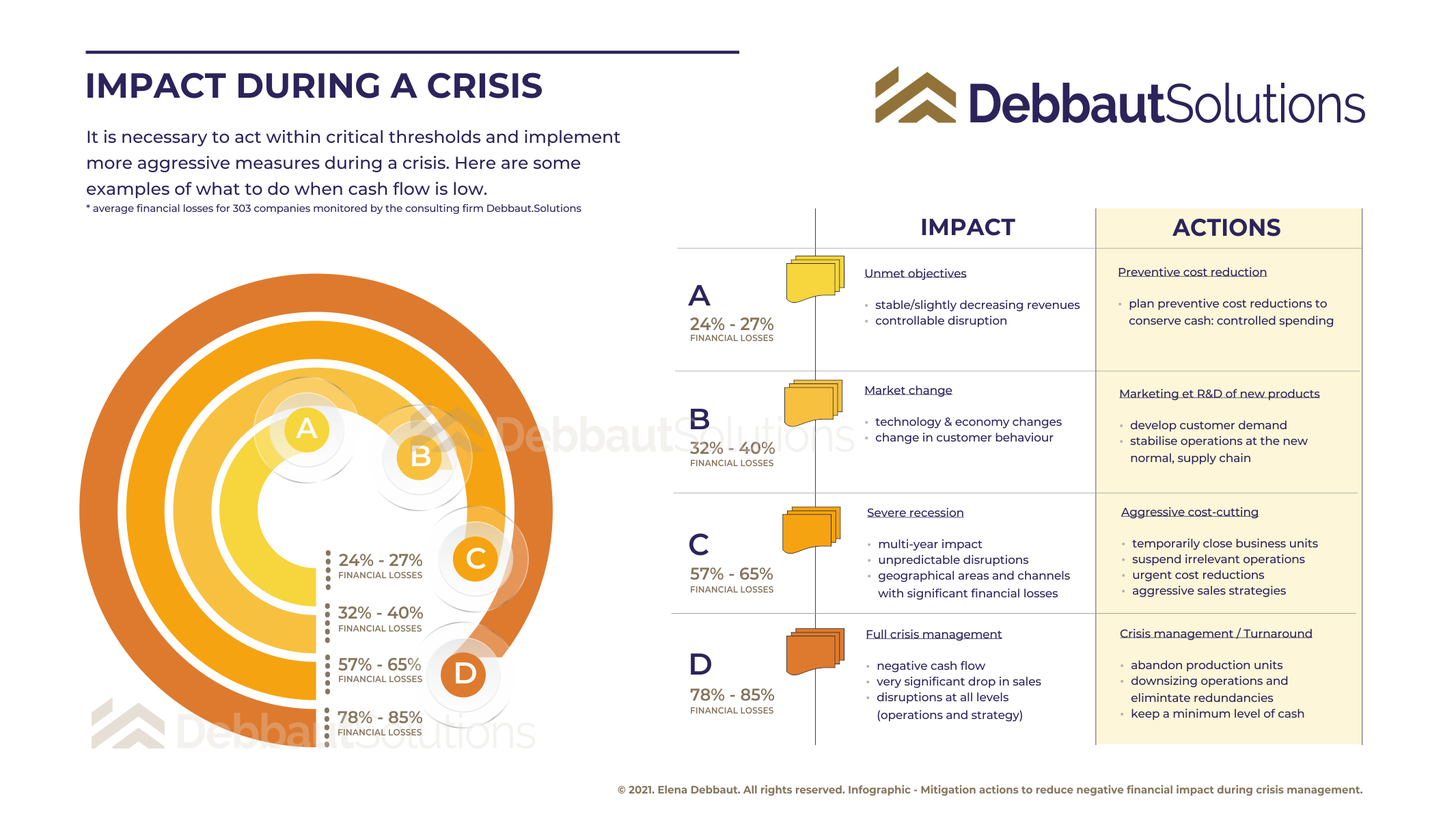
During a crisis, it will be necessary to act according to critical thresholds and for which business leaders should decide on more radical strategic measures. Here are some specific examples of managing a situation of declining liquidity (see the illustration in Fig. 2 for the financial and operational impact during a crisis).
download the .pdf version of this business infographic
During the preliminary planning phase, it is important to note that the average financial losses I regularly observe during a typical crisis management mandate with our consultancy are not limited to specific sectors or industries. Moreover, the impact of crises can be cumulative, as well as the actions I recommend.
24% to 27% financial losses
Impact: unmet objectives
• stable or slightly decreasing revenues
• controllable disruption to current operations
Actions: preventive cost reduction
• plan preventive cost reductions to conserve cash and control spending
32% to 40% financial losses
Impact: market change
• market changes (technological, economic)
• change in customer behaviour
Actions: marketing and R&D of new products or services
• develop customer demand
• stabilise operations at the new normal, supply chain
57% to 65% financial losses
Impact: a severe recession
• multi-year impact
• unpredictable disruptions
• geographical areas and channels with significant financial losses
Actions: aggressive cost-cutting
• temporarily close business units
• suspend irrelevant operations
• urgent cost reductions
• aggressive sales strategies
78% to 85% financial losses
Impact: full crisis management
• negative cash flow
• very significant drop in sales
• disruptions at all levels (operations and strategy)
Actions: crisis management/turnaround
• abandon production units
• downsizing operations and eliminating redundancies • keep a minimum level of cash
The ideal composition of teams for crisis management programs
Business leaders can assign crisis management to full in-house teams or by an external task force.
Both solutions are highly strategic decisions that reduce operational risks during a crisis. Most importantly, outsourcing the crisis management process is the only solution that allows us to use on-the-ground experience without taking risks with a workforce in a fluctuating market and thus reduce the risks related to the security of factual information and actions.
As the business world adapts to a new reality of ensuring business continuity, outsourcing these management risks is an extremely important survival tactic. Risk management service providers and consultants have excellent levels of experience in providing business continuity.
Finally, depending on the type of company, size, and geographical area, this strategic choice is more realistic and affordable than the internal formation of a crisis management team.
How a consulting firm can help you with your crisis management
There are many ways to work with a consulting firm, whether during a crisis, preventive or even post-crisis.
Workshops and hands-on workshops with the management team
• Organisational learning can improve by sharing the consulting firms’ macro-economic forecasts and research, impacting the company, its sector of activity, or even its geographical area.
• Strategic alignment of operations with the magnitude of past, present or future disruptions, and alignment with the magnitude of future disruptions.
• Sharing of best practices and operational strategies that have proven successful in the field.
Establish an effective continuity plan and specific actions
• In-depth examination of the most critical areas, business units and aspects during a crisis, developing a detailed action plan with clear milestones and checkpoints.
• Organization of the company structure according to a model that crisis managers, interim directors, or business leaders can quickly implement during a crisis (task force, business continuity plan, crisis management strategy)
• Team selection for effective strategic and operational alignment during a crisis
• Creation of a chain of command to facilitate decision making in a crisis. Before a crisis, the “learning and sharing” approach can achieve operational excellence results by establishing a temporary work rhythm to complement the existing operational strategy or setting up a dedicated crisis management team. During a crisis, business leaders can do this by establishing a temporary workflow to complement the current operating strategy or with the help of a dedicated crisis management team.
Crisis scenario modelling and testing
• Pre-crisis analysis or analysis during a crisis of various crisis scenarios such as the immediate shutdown of certain operations or production sites or risk-taking with the launch of new products and services.
• Implementation of a monitoring tool for early warning signals of crisis, monitoring of stress tests and likely financial impacts such as business scenario analysis on revenues and liquidity.
• Prediction of aggravating scenarios on the management of current operations.
• Analysis of organic growth opportunities during a crisis or quickly afterwards and strategic and operational recovery plans, predicting future customer behaviour.
✽✽✽
In conclusion, business continuity planning involves not only an ad-hoc reaction but also an analysis of the possibilities for organic growth during a crisis or immediately afterwards, as well as strategic and operational recovery plans, with a sound prediction and intuition about the new customer and market behaviour.

Elena Debbaut is a strategic execution expert to boards and executive teams. She leads and advises on complex transformations when governance barriers, internal politics, or structural fragmentation prevent organizations from executing critical decisions.
Specialities:
• governance-constrained transformation
• operational restructuring
• strategic recovery & execution